
The Origins of Money
__________________
René Guénon in his masterpiece The Reign of Quantity and the Signs of the Times, included a chapter titled The Degeneration of Money.
To trace the origins of a qualitative conception of money understood as an epiphany of the sacred in traditional civilizations, reading Jean Haudry’s book Juno Moneta is extremely useful.
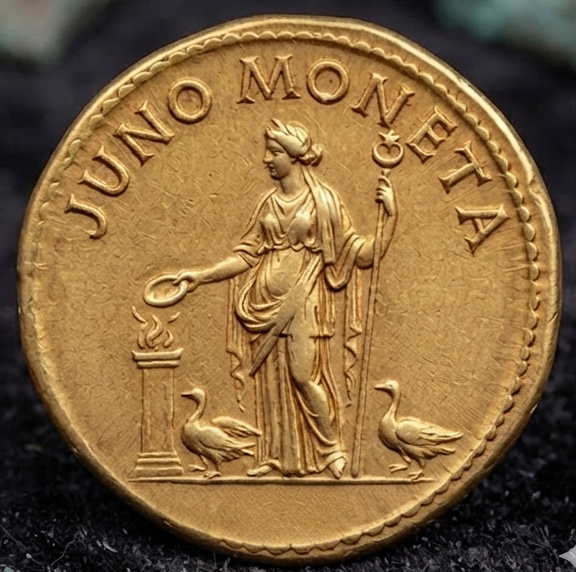
The French scholar investigated the etymology of the word “moneta“, which traces back to an attribute of Juno: the mint of ancient Rome was housed in the temple of Juno Moneta, which is why the word “moneta” came to designate money.
The etymology most frequently proposed by classical authors for the word “moneta” derived from the verb “monere” and perhaps alluded to the fact that the geese of the Capitoline Hill, which guarded Juno’s temple, had warned the Romans of the attack by the Gauls. However, Haudry notes that this explanation is hardly consistent: from the verb “monere“, one should rather expect “monitrix” as a derivative, and furthermore, there is no direct relationship between the geese of the Capitoline Hill and money.
The etymology of “moneta” should instead be sought in the Indo-European root “moni“, which indicates the neck, and in its derivatives denoting necklaces and jewelry hung around the neck (for example, the Latin “monile“). Therefore, Juno Moneta would not be Juno who “warns,” but Juno who “wears the necklace,” and this attribute would allude to the paleomonetary function of necklaces and jewelry—a function widely attested by all anthropological studies.
Haudry traces figures of necklace-bearing goddesses across various Indo-European traditions. The most famous is undoubtedly Freya, the goddess of love in Germanic mythology: the Nordic Venus wore a necklace called “Brisings“, which had been crafted for her by dwarves in exchange for a night of love spent with them.
The necklace of these deities evidently also alluded to the light of dawn, as in the case of the Celtic Brigit, and Haudry himself has dedicated significant studies to the function of Juno-Hera as the dawn goddess. Certain engravings in Val Camonica also bear witness to the solar valence of necklaces.
The author also thoroughly analyzes the story of Tarpeia, who let the Sabine soldiers in to get her hands on their gold bracelets. This episode falls within the framework of “foundation wars,” a widespread theme in the Indo-European world extensively studied by Dumézil. The Sabine Tarpeia, who lives with the Romans, is likened to Freya, who belongs to the Vanir gods but will pass into the ranks of the Aesir gods: these are episodes that illustrate the mortal danger of xenophilia for a nation. Furthermore, these foundation wars staged a people with warlike attitudes and a people inclined to pay to obtain peace: from the clash of these attitudes, a new population was formed. Such myths represented the transition from a society based on hereditary castes to a society founded on classes defined by the possession of alienable goods that can be quantified through money. The destructive effect of monetary circulation had also manifested in ancient Greece, as a consequence of the mercantile trade of the colony metics, who had degraded money to a purely quantitative function.
As always, Haudry supports his theses with an exceptional amount of data and casts an original glance upon legendary tales and philological details. Particularly interesting is the analysis of the rites of Juno Moneta, during which the singular ceremony of the crucifixion of dogs took place. It is traditionally believed that this rite originated from the fact that during the attack of the Gauls, the dogs had not barked, whereas it was the geese that had awakened the Romans. However, Haudry does not rule out that the rite may refer to certain infernal and maleficent attributes linked to dogs, as evidenced by mythological and folkloric elements.
Haudry’s study serves as an important pathway for deepening research into the religious origin of money, in contrast to the utilitarian theories that unfortunately still enjoy so much credit in the dominant culture.
***
Jean Haudry, Juno Moneta. Aux sources de la monnaie, Archè, Paris / Milan 2002, pp.200
_______________________________
Text translated from Italian into English by Google Gemini in 2026
(Image generated by Google Gemini)

