Le profezie di 1985

Bev Jones, insegnante di storia, vive nella Londra del 1985, una città in gran parte islamizzata: Elisabetta II ha abdicato e regna Carlo III, ma i paesi arabi ricattano l’Inghilterra con le forniture di petrolio e stanno assumendo il controllo del paese. Truppe algerine di lingua francese occupano isole britanniche nella Manica dove instaurano una teocrazia musulmana, mentre gli sceicchi prendono ragazzine minorenni inglesi come concubine. I sindacati sono onnipotenti e, con i loro scioperi a oltranza, paralizzano la vita sociale ed economica inglese al punto che i pazienti di un ospedale muoiono in un incendio a causa di uno sciopero dei pompieri. Tutti i lavoratori sono inquadrati in sindacati che hanno un potere immenso, i padroni privati stanno sparendo e quasi tutte le attività sono statali. Il governo elabora una “neolingua” chiamata “inglese dei lavoratori”, una lingua estremamente semplificata che riflette l’appiattimento del pensiero, e le città sono tappezzate da manifesti che rappresentano “Bill il Lavoratore” (una figura che richiama Stachanov). Bev ha una figlia di 13 anni con qualche ritardo mentale che passa il tempo a guardare la TV e a masturbarsi: la fanciulla si intrufola nuda nel letto del padre il quale le spiega che il sesso incestuoso è una cosa malsana! Bev decide di cambiare lavoro e comincia a fare l’operaio in una fabbrica di cioccolato perché non vuole insegnare nella scuola ideologizzata di regime. Le città sono infestate da bande di teppisti minorenni e sono frequenti le violenze sessuali pederastiche. Ci sono oppositori del regime che si riuniscono in segreto e che cercano di diffondere informazioni alternative, ma i dissidenti vengono rinchiusi in manicomio. La popolazione inglese più reattiva è divisa fra coloro che tentano iniziative per opporsi al sistema e quelli che sono affascinati dalla forza morale dell’Islam nei confronti di un Occidente sprofondato in uno stato di degenerazione irrecuperabile. A Londra si sta costruendo una grande moschea che viene presentata anche come tempio ecumenico. I lavoratori entrano in sciopero e la polizia li disperde, mentre per proseguire i lavori vengono utilizzati crumiri arabi. Alcuni scioperanti assaltano i quartieri islamici e vengono accusati di razzismo…

Come sarà il futuro dell’Inghilterra?

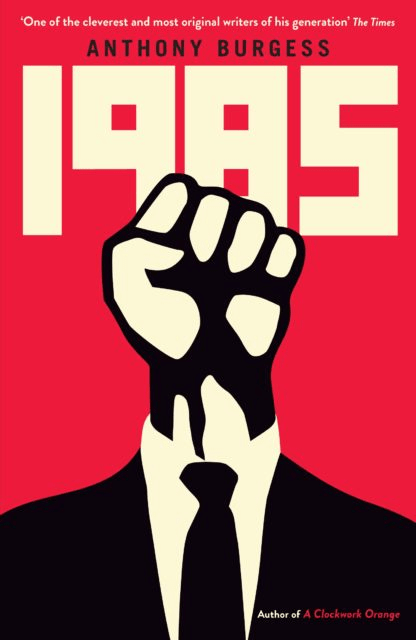
Questi, in sintesi, sono gli ingredienti di 1985, racconto distopico di Anthony Burgess, il geniale autore di Arancia meccanica. Il libro 1985 viene pubblicato nel 1978 e il titolo richiama ovviamente 1984 di Orwell (il libro è stato tradotto in italiano col titolo 1984 & 1985 nel 1979). In 1985 Burgess intendeva confrontarsi idealmente col maestro della distopia. 1985 è diviso in due parti: una contiene il racconto fantapolitico sull’Inghilterra del futuro e l’altra contiene brevi saggi e riflessioni sull’opera di Orwell e sulle ipotesi di futuri cambiamenti sociali e politici.

Burgess immaginava un controllo sempre più capillare sulla vita dei cittadini (lui stesso racconta che la CIA aveva messo sotto controllo il suo telefono durante la sua permanenza a Roma) e notava anche come già nell’Utopia di Tommaso Moro ci fosse il germe del controllo sociale. Un capitolo di 1985 è dedicato al censimento inglese del 1971: un momento importante nella storia del Regno Unito perché rappresentò la prima intrusione dello stato nella vita privata di tutti i cittadini, con tanto di multa per chi non rispondeva alle domande.

Burgess prevedeva anche che in futuro i termini considerati razzisti o omofobi sarebbero stati vietati per legge. Questi termini erano già considerati tabù quando il nostro autore scriveva e occorre notare che all’epoca non si utilizzava ancora il termine “omofobia”, capolavoro della neolingua politicamente corretta entrato nell’uso comune all’inizio del XXI secolo.

Del resto già nel 1962 nel romanzo The Wanting Seed (Il seme inquieto), Burgess prefigurava una società governata da omosessuali nella quale le persone eterosessuali erano soggette a rigorosi controlli e limitazioni…

Il tema dell’omosessualismo cominciava ad emergere negli anni ‘60 e Burgess ha avuto modo di osservare i primi segnali di questo nuovo fenomeno sociale, che oggi ha assunto la portata di un evento messianico!

Inoltre non mancano pagine sarcastiche dedicate ai grotteschi tentativi di femminilizzare il linguaggio: istanze che l’autore inglese prevedeva negli anni ‘70 e che oggi trovano spazio anche a livello istituzionale…

Secondo Burgess il futuro vedrà l’eliminazione dei legami sentimentali e famigliari, la perdita del diritto di scelta morale, il trionfo della “logocrazia”, ovvero della capacità di esprimere concetti contraddittori accettandoli entrambi (il bipensiero di Orwell). Si trovano poi osservazioni sul romanzo Noi di Zamjatin, considerato il più diretto antecedente di 1984, nonché riflessioni sull’influenza del pensiero anarchico e delle teorie di Pavlov e Skinner in relazione all’applicazione sociale dei riflessi condizionati.

Possiamo chiederci fino a che punto siano state precise le profezie di 1985. Gli eventi si svolgono in un arco di tempo molto stretto: il libro viene pubblicato nel 1978 e immagina eventi che si svolgono circa sette anni dopo, ma occorre considerare che l’anno scelto come titolo del libro era un intenzionale richiamo al romanzo di Orwell. Burgess era un conservatore inglese e nel momento in cui scriveva era colpito dal potere delle organizzazioni sindacali che negli anni ‘70 avevano una notevole capacità di mobilitare i lavoratori. In realtà di lì a poco i sindacati avrebbero ingaggiato contro Margaret Thatcher una prova di forza dalla quale sarebbero usciti irrimediabilmente sconfitti. Inoltre si era ancora in piena guerra fredda e c’era in Occidente un persistente timore per la diffusione di idee collettiviste. Burgess tuttavia è riuscito a individuare il tema dell’immigrazione come asse portante del dibattito politico dei tempi a venire. Come si è detto il nostro autore immagina addirittura che ci siano scontri fra gli scioperanti inglesi e i magnati musulmani che hanno commissionato i lavori per la moschea. In realtà le cose non sono andate proprio in questo modo: l’opinione pubblica si è lasciata ipnotizzare dalla propaganda antirazzista che si è rivelata un eccellente anestetico per far dimenticare i diritti sociali. Il neoliberismo ha utilizzato proprio l’antirazzismo per attaccare i diritti dei lavoratori, spesso con l’entusiastico consenso di questi ultimi. Come sempre accade la letteratura distopica alterna sorprendenti anticipazioni sul futuro a clamorosi abbagli…

Del resto gli avvenimenti degli ultimi decenni sono stati talmente assurdi da superare gli sforzi immaginativi delle più fervide fantasie!

Il titolo che conclude la sezione di saggi di 1985 è indicativo: “La morte dell’amore”. E, potremmo aggiungere oggi, “Il trionfo dell’odio”, poiché la morale del rancore e della vendetta che anima le ideologie progressiste ha ormai assunto valenza normativa.

_________________________________________________________________

Anthony Burgess, 1985, Serpent’s Tail, p.219

1985 – Serpent’s Tail (serpentstail.com)

***

Anthony Burgess, 1984 & 1985, Editoriale nuova, 1979, p.355
Castes and Races

The ideology of anti-racism is the veritable opium of the people: this powerful drug is cunningly used by the ‘democratic’ ruling class to distract public opinion from the most pressing problems and to make civil society swallow the new world order that takes the form of a surreal ‘multiracial’ society that in fact inevitably takes on the characteristics of a multi-criminal society. ‘Fighting discrimination’ is an expression that has a lysergic effect on the weak, fragmented and easily impressed personality of contemporary man, who has regressed to the infantile stage and is willing to believe the most far-fetched fairy tales.

In contrast, the world of Tradition was founded on a strong feeling for the identities of race, caste and religion. Frithjof Schuon’s book Castes and Races, which the author published in French in 1957, is very useful for understanding these aspects of the history of mentality. Schuon was one of the most qualified scholars of the history of religions, which he interpreted in the light of the philosophia perennis, highlighting the similarities between cultures distant in time and space. Castes and Races is a highly topical text that anticipated by decades the differentialist conceptions prevalent in the cultural debate today.

Schuon’s treatment opens with a definition of the caste institution, which finds its justification in the differentiation of human types with the consequent diversity of attitudes and qualifications. In Hinduism, the caste system had its strictest application based on the principle of caste inheritance, while in Judaism and Islam castes are absent, since in these cultures the egalitarian consideration prevailed according to which all men were created in the image and likeness of God. Between these two conceptions is medieval Christian Europe in which society was divided into castes, but in a fairly flexible manner: the priestly caste was vocational and the warrior caste could take in elements of the workers’ castes through ennobling processes, and in this way the eventuality of a peasant becoming pope and consecrating emperor could occur. But the members of the castes, even the humblest, each had their own dignity and specific qualities that determined their social function. Ancient hierarchical societies also created spaces for individuals with no particular aptitudes, with a chaotic and ill-defined psychology, and therefore prone to transgression: to protect the social order from the contamination of these elements, the groups of the ‘outcastes’ and ‘untouchables’ were formed in the Hindu world, or the Jews and Gypsies in the Western world. The modern mentality, founded on egalitarian conceptions derived from crude and improbable materialist ideologies, and particularly averse to the principle of heredity, considers it unacceptable to divide humanity into castes. But ancient castes, as we have seen, had a social function that balanced human aptitudes, whereas modern materialism has turned mediocre elements into a ruling class and has in fact overturned the meaning of castes, assigning completely unjustified prerogatives and privileges to the incapable and parasitic, and leading to the social dysfunctions that characterise the contemporary world. In antiquity and the Middle Ages, men had a clear awareness of the sense of limitation and were aware of the risks that humanity ran if it gave way to demonic forces outside the horizon of the sacred. In the modern world, however, the mechanisation and technologisation of the economy have created the mass of the ‘proletariat’, which does not correspond to a natural caste but to a quantitative collectivity.

To account for the absurdities it is responsible for, modern culture has even managed to give a pseudo-religious superstructure to its ‘humanitarian’ conceptions. Humanitarianism, in fact, holds that the totality of human beings is the personal God: a conception that degrades the divine to the human level, whereas in the traditional conception it is the human that strives to rise to the divine. From this idea of the sacred derives an equivocal charity that saves bodies but kills souls; people’s faults are attributed to unfavourable material conditions, so consciences are derelict, as deviant and criminal behaviour is accepted and encouraged on the basis of the ‘sociological’ explanations that are so successful in contemporary culture. Third-worldism, then, has managed to elaborate concepts that are, to say the least, misleading about the idea of ‘welfare’. The notion of an ‘underdeveloped country’, in its candid perfidy, is inspired by a crudely materialist conception of life: for progressives, happiness consists in a technological development destined to destroy many elements of beauty, and therefore of well-being, while they forget that atrocities exist on the spiritual plane, and with these atrocities the humanitarian culture of moderns is saturated. In the name of humanitarianism, vocations are trampled upon and people of genius are humiliated in a school system whose purpose is no longer to select the best, but to homogenise intelligences in the prevailing mediocrity.

Schuon points out that modern democratic levelling is at the antipodes of religious egalitarianism: the equality of monotheistic religions, in fact, is based on the theomorphism of man, whereas democratic equality takes animality as its model. In the religious conception of life, men are expected to see in their neighbour the image of God and to treat each other as ‘virtual’ saints: in this sense, even the humblest assume an aristocratic demeanour. Modernity, on the other hand, by elevating progress to an ideology, has taken wealth as the yardstick by which all things are judged, viewing poverty as a kind of curse and creating odious forms of social exclusion far more rigid than those enacted by the caste system. Similarly, modern ideologies have claimed to annul the differences between men and women, destroying the natural family and creating the scenario of social disintegration that modernity has placed before our eyes.

Turning to the subject of race, Schuon immediately makes it clear that caste prevails over race, since race is a form, while caste is a spirit, and spirit prevails over form. It would be absurd, however, to think that racial differences do not imply differences in attitudes and attitudes: if it is right to reject racially inspired feelings of hatred, it is equally right to reject a prejudicial anti-racism that claims to standardise all diversities, with the obvious aim of providing the power of globalist technocrats with a mass of citizen-slaves incapable of critical thought.

Schuon analyses the three main racial groups into which humanity is divided, Whites, Blacks, Yellows, which he likens to the natural elements: White to the sky, Black to the earth, Yellow to water. Each of these races has given rise to social organisations inspired by their respective characteristics, and within these large groups there are further differentiations, due to cultural and historical factors that have marked the various civilisations. In particular, within white culture there have always been moments of confrontation, and sometimes conflict, between Nordic cultures and Mediterranean cultures, as well as between pagan mentality and Christian mentality, between monotheistic messianism and Aryan avatarism.

Schuon also emphasises the important distinction between peoples and states: in fact, the people does not always coincide with the state, indeed in the modern world more and more often different peoples live within the same territory, which is precisely why today it is all the more important for ethnic groups to acquire a clear awareness of their identity. Indeed, while racial mixing can ventilate an overly closed environment, it also risks the disappearance of human groups with precious qualities: the model of the multiracial society, besides being a blatant failure in terms of social cohesion, represents an impoverishment of human cultures, which should be enriched in the confrontation of differences, rather than mutually annihilating each other in global homologation. Schuon concludes the book with a consideration that effectively sums up the meaning of the racial question beyond any ideological forcing: “the qualities that make a certain human being lovable, make the genius of his race lovable at the same time…the man of another race is like a forgotten aspect of ourselves, and therefore a found mirror of God”.


Frithjof Schuon, Castes and Races, Sophia Perennis, 1982

Castes and Races: Schuon, Frithjof, Pallis, M., Matheson, M.: 9780900588228: Amazon.com: Books

Criticism of Guénon

Against Guénon?


René Guénon is an undisputed authority on the traditional approach to historical and philosophical studies, and his writings are becoming increasingly popular and gaining ever more passionate readers.

However, there is no shortage of critics and detractors of the great French intellectual: a recent essay in this vein is Contre Guénon by Belgian writer Jean van Win. The author is an avowed supporter of ‘democratic values’ (drugs? abortion? mafia? corruption?). For van Win, democracy, equality, women’s emancipation, are principles worth living for and, if necessary, dying for: at the apex of these enlightened values, van Win places the ‘duty of interference’ (let’s try to imagine the Belgian scribbler with helmet and bulletproof vest fighting in ‘humanitarian’ wars…).

To make the author’s positions clearer, the volume’s introduction states that he wishes to emphasise the extraneousness of Guénon’s thought to Masonic humanitarianism, but we have no doubts anout this!

Therefore, the objections that Van Win raises against Guénon are those usually used by the progressive nonsense that we hear every day in the mass media. Guénonian thought is likened to fascism to nazism, to racism, to anti-semitism: all these arguments have a great effect on the larval psychology of the democratic flock…

For our enlightened essayist, René Guénon’s cordial intellectual friendship with Julius Evola is a scandalous fact, even though in reality the two authors, although starting from a common critique of modernity, developed rather different strands of thought.

The author then mocks the world conspiracy theory of which Guénon was a careful scholar. Now that globalism is openly manifested with so much institutional recognition, the denialist thesis of regime propaganda debunks itself

Where van Win’s essay reaches tragicomic results is when the author attacks the fideistic attitude of traditionalist culture: if readers apply this critique to the egalitarian dogmas of contemporary culture, they will have a good laugh…

Beyond the cultural positions of the author of Contre Guénon, in the essay one can find reasons of interest on some points concerning Guénon’s formation, his sources, his eclectic cultural frequentations. First of all, the fascination for the East seems due to a cultural fashion that has very ancient roots in Europe and, in particular, in France: the idea of the East as a place of origin, as an exotic horizon bearer of who knows what mysteries has always been a widespread commonplace. Guénon was particularly fascinated by India, which, however, he never had the opportunity to visit and, according to van Win, Guénon did not know Sanskrit and read Hindu texts only in translation. The French esotericist also frequented some Masonic lodges, but he was one of the most qualified contributors to the anti-Masonic press of the time! The conversion to Islam, then, contrasts with the passionate defence of the Catholic Church, of which Guénon was often a standard bearer in his writings. Finally, Guénon rarely cites the sources from which he drew inspiration.

Certainly, the life and work of Guénon can present ambiguous and contradictory aspects, but there is no doubt that the body of his writings describes with extraordinary precision the frightful metastasis of democratic degeneration. The denunciation of the pan-Satanism that infests the modern world has never been so convincing as in Guenon’s lucid pages, which nevertheless never induce despair, but on the contrary encourage the reader, with an almost imperturbable language, to a firm stance and a virile assumption of responsibility.

Finally, it should be noted that van Win reproaches Guénon for the absence of references to Christian love. In reality, van Win himself, an author of clear Masonic sympathies, does not really express himself as an altar boy; and on the other hand it is universally known that egalitarian ideologies are by definition the factory of hatred!


Jean van Win, Contre Guénon, Éditions de La Hutte, Bonneuil-en-Valois 2010, pp.278