
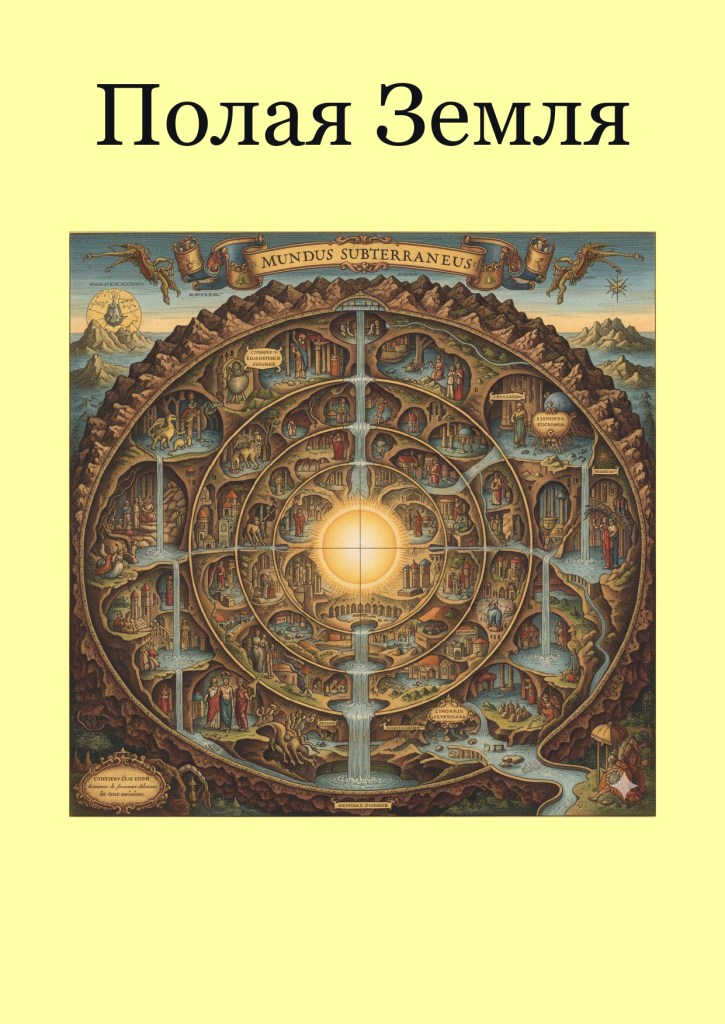
Hollow Earth (Russian Language) – FREE eBOOK
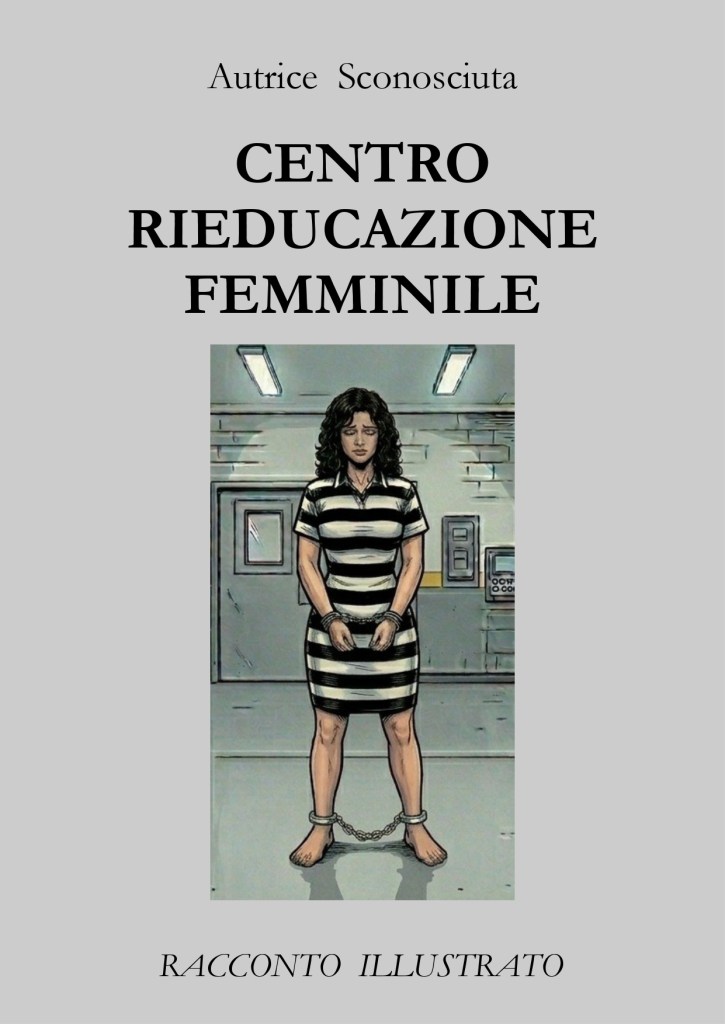
Dopo i caotici esperimenti femministi del XXI secolo, gli uomini hanno abbattuto la società femminilizzata e hanno restaurato l’autorità patriarcale riprendendo il ruolo guida cui i maschi sono naturalmente destinati. Il colpo di genio del regime patriarcale per ottenere il controllo del genere femminile è stata un’idea semplice ma estremamente funzionale: vietare le calzature femminili.
Le donne devono camminare a piedi nudi: sempre, senza eccezioni, non ci sono scuse!
Questo significa mobilità limitata e vulnerabilità ma soprattutto, simbolicamente, per le donne camminare scalze è segno di umiltà e sottomissione. In questa condizione le donne interiorizzano spontaneamente l’osservanza della disciplina patriarcale.
Sebbene le donne siano felici di essere tornate ai loro ruoli naturali di cura della casa e della famiglia, si verificano di tanto in tanto episodi di disobbedienza alla regola dei piedi nudi femminili. Le autorità sono preoccupate, il clima di armonia e serenità che il regime patriarcale ha instaurato potrebbe essere solo apparenza: per quale misteriosa ragione alcune donne sembrano insoddisfatte di questo stato di cose?
_________________________________________________
Autrice Sconosciuta
CENTRO RIEDUCAZIONE FEMMINILE
racconto illustrato
____________
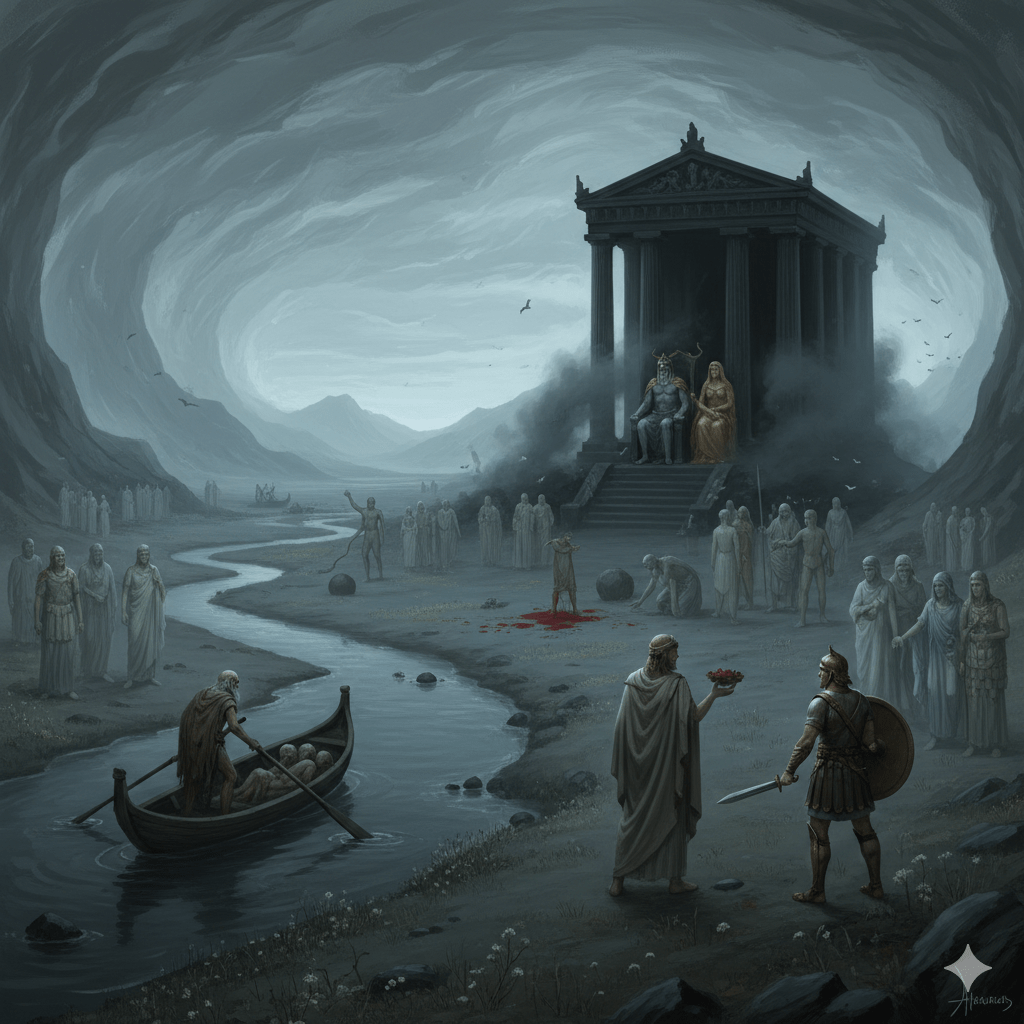
The Victrix publishing house performs a commendable service in disseminating classical culture; a truly significant title in its catalog is Le credenze d’oltretomba nelle opere dell’antichità classica (Afterlife Beliefs in the Works of Classical Antiquity) by Carlo Pascal. First published in 1911, the book remains a useful guide today for surveying the sources regarding conceptions of the afterlife in the ancient world.
The general conception of the afterlife in the Western world is essentially shaped by the descriptions in the Divine Comedy, yet Dante was himself deeply indebted to the depictions of the underworld provided by ancient literature. Furthermore, references to the afterlife in the Bible are quite vague in both the Old and New Testaments, whereas the pagan world appears to have held more precise ideas about the otherworldly realm.
Among the oldest recorded customs is the offering of crowns to the dead, as if they were victors in an ideal race of life: from this concept emerged a sense of immortality that assimilated men to the gods. Ancient literature, from Homeric times onward, describes the Realm of the Dead—initially with distressing tones (such as the shade of Achilles in the Odyssey), and later with hopes of happiness that find their greatest expression in Virgil’s “Elysian Fields.” Generally, one observes that in the earliest stages, the abode of the dead is perceived as a shadowy and indistinct place; over time, clearer conceptions emerge. The posthumous condition appears increasingly linked to the deceased’s conduct during life, with corresponding rewards and punishments. This framework transitioned into Christian views of the afterlife, eventually leading to the medieval development of a temporary place of suffering that prepares souls for Heaven: Purgatory.
Pascal’s study examines the locations and figures of the underworld: from the infernal rivers to the Furies, from the Etruscan-origin demon Charon to the judge Minos. Pascal consistently references primary sources, including not only great literary works but also the philosophical doctrines of various ancient schools, as well as sepulchral inscriptions and Orphic fragments, identifying interesting connections with Jewish and early Christian apocalyptic literature. This entire heritage of the imagination would later be masterfully utilized by Dante Alighieri.
In ancient Rome, the conception of the afterlife also had political reflections through the deification of emperors (apotheosis). Ancient writers recount that numerous prodigies occurred upon the death of Caesar, and rumors spread that he had been taken up to heaven among the gods. The Roman ruling class saw the deification of the emperor as an opportunity to strengthen the sense of the state, to the extent that Augustus himself was depicted with a halo—which would later become the hallmark of sanctity in Christianity. Once again, we see how the new religion integrated itself into an already well-defined system of values and symbolic references.
It is to be hoped that the reissue of Pascal’s book paves the way for the rediscovery of his other works on ancient religious history and Medieval Latin literature, of which Pascal was a meticulous scholar.
******
Carlo Pascal, Le credenze d’oltretomba nelle opere letterarie dell’antichità classica, Victrix, Forlì 2006, pp.266
_______________________________________
«But if oxen and horses and lions had hands and were able to draw with their hands and do the same things as men, horses would draw figures of gods similar to horses and oxen similar to oxen, and they would fashion bodies just as each of them is fashioned».
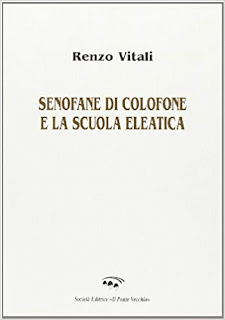
This is the most famous fragment of Xenophanes of Colophon, the Pre-Socratic philosopher whom some have considered the champion of radical skepticism, or even a pioneer of monotheism. The figure of Xenophanes is, in reality, far more complex; anyone wishing to deepen their knowledge of his thought must take into account the book by Prof. Renzo Vitali, which is the most substantial monograph written in Italian on the subject: Senofane di Colofone e la scuola eleatica (Xenophanes of Colophon and the Eleatic School).
Vitali’s book takes its cue from K. Reinhardt’s study Parmenides und die Geschichte der griechischen Philosophie (Bonn, 1916). In that publication, which exerted great influence throughout the 20th century, Reinhardt argued that Xenophanes was not part of the Eleatic school and therefore had no direct relationship with Parmenides. Furthermore, many scholars have viewed Xenophanes as a kind of religious reformer, whereas an assessment more attentive to the historical context shows how Xenophanes’ presumed theology is nothing more than an expressive mask. Despite the lucubrations of modern scholars, the doxography of ancient authors is unanimous in taking Xenophanes’ belonging to the Eleatic school for granted, with Aristotle maintaining that Parmenides had been a pupil of Xenophanes.
Only about thirty fragments of Xenophanes’ works have survived. He wrote poetic works as well as a monumental historical poem on the foundation of Colophon. Xenophanes was likely convinced that this poem was his most important work; instead, the Greek thinker has gone down in history for the philosophical fragments born in an era when Hellenic literature began to abandon the ancient values of warrior heroism to outline a model of man who acts in accordance with justice (dike) and the utility of the city (polis).
Into this cultural climate bursts the thought of Xenophanes, who contests the archaic religiosity of Homer and Hesiod and opens a cultural path more suited to new anthropological models. Human science is not absolute knowledge, but rather an effort of inquiry aware of its own limits. Truth—the absolute certainty—is the exclusive domain of the gods and cannot be bestowed all at once upon men. Instead, by searching over time—which is the phenomenal veil of Being—men move toward the reconstruction of the original unity. Vitali believes that by virtue of this path of inquiry (zetesis), Xenophanes is far from a skeptical attitude; rather, the philosopher wishes to emphasize the relativity of judgment, the difference between opinion and reality. As for the alleged Xenophanean “monotheism,” it must be noted that while Xenophanes often speaks of a god in the singular (in opposition to the anthropomorphic gods of the older Greek tradition), he believed that the god was identified with the world considered in its unity. It is clear, therefore, how this conception was entirely distant from the idea of the personal God of the Bible.
Vitali then draws attention to the terms dokos and doxa used by Xenophanes and other Pre-Socratics. The term dokos anciently indicated the beam of a roof in a building; the semantic indication remains the same even in the different meaning acquired, as the acceptance of an opinion is the very “covering” through which one sees and regards the new spatial reality of the constructed house. Doxa is the covering put together by the aesthetic frameworks through which man arrives at the construction of the entity (ens) seen and known in such a scientific manner. What gives sense to human perceptions is the noos common to gods and men: the connecting point that allows the divine to be linked to the human, as can also be seen in the ancient Orphic conceptions, according to which gods and men breathe from the same mother.
Vitali devotes a chapter of the book to a comparison between the terminology of Xenophanes and that of Parmenides, contrasting lexical modules, stylistic features, and the conceptions of the two philosophers. The extraordinary consonance of words and concepts makes it highly probable that Xenophanes was Parmenides’ teacher, or at least that Xenophanes’ influence on Parmenides was decisive. In particular, there is no difference between Xenophanes’ god and Parmenides’ Being: both represent the Absolute.
The final part of the book is dedicated to Xenophanes’ conceptions of physics, which, as is well known, was the privileged field of research for these early thinkers. The theme is particularly interesting for its philological implications. Indeed, it is first necessary to establish what meaning certain terms had in such ancient times and within the context of a scientific language. Exemplary, for instance, is the case of apeiron, generally translated as “infinite,” but which requires specific in-depth study (recall, in this regard, the imaginative hypotheses of Giovanni Semerano). Furthermore, Xenophanes’ use of the word psyche is the first evidence of this term being used in a sense different from the Homeric one.
The cultural experience of Xenophanes represents a significant moment in the history of philosophy: with him, thought failed the requirement to grasp the unity of the whole of reality; the results of its efforts were always lacking and distorted. Since then, the recurring doubt that man, instead of discovering the laws of the universe, creates them himself, has run through all of Western thought up to the contemporary outcomes of existentialism and “weak thought” (pensiero debole). As we can see, the cultural space separating modern man from the first Greek thinkers is indeed narrow, and the philosophical themes of the Pre-Socratics—which we know only in fragmentary form—contain in potential all the themes that would be developed in over two thousand years of philosophical speculation.
***
Renzo Vitali, Senofane di Colofone e la scuola eleatica, Società Editrice «Il Ponte Vecchio», Cesena 2000, pp.160
“The most evil of humans is yet to be born.”
This sentence appears in Ferdinand Ossendowski’s book, Beasts, Men and Gods. Ossendowski’s work was published in 1922; if at that time the most evil of humans had not yet been born, the impression at the dawn of the 21st century is that humanity’s most wicked elements are not only already among us, but are in the full manifestation of their demonic powers, as evidenced by the abominable developments of globalism…
In this light, re-reading Ossendowski’s classic is far from a mere scholarly exercise; it can still provide useful indications for an esoteric interpretation of contemporary events.
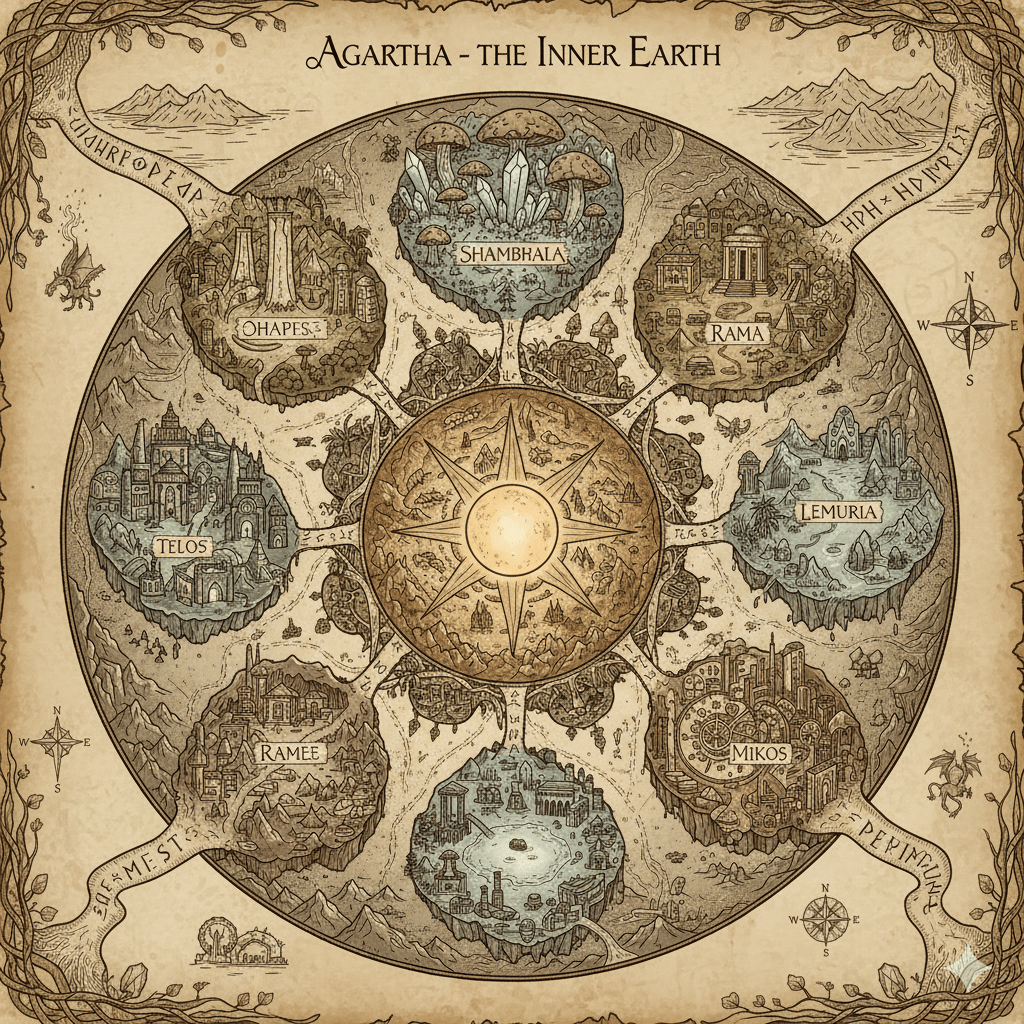
Louis de Maistre’s recent essay, Dans les coulisses de l’Agartha (“Behind the Scenes of Agartha”), is a wide-ranging study of the Polish author and his extraordinary adventure in the Asian wildlands. De Maistre’s book serves as a valid support for retracing the fascinating themes of Agartha and the King of the World—concepts made famous by René Guénon but already known through oral traditions and esoteric literature.
The events narrated in Beasts, Men and Gods, centered on the epic of Baron Ungern von Sternberg, are little known to the general public, yet they are by no means secondary. In those years, not only were the final phases of the Civil War between the Whites and the Reds unfolding in revolutionary Russia, but a crucial “chess game” for the control of Asia was being played between Russia, the British colonial power, China, and Japan. Official Soviet historiography depicted Ungern as a pawn manipulated by Japan, but the reality appears different: the “Mad Baron” was a romantic warrior driven by an unshakeable faith in counter-revolutionary ideals. Ungern von Sternberg, as is well known, intended to conquer Mongolia to use it as a base from which to unleash the Oriental masses against the West, which he held guilty of embracing the materialist ideologies of which Communism represented the most monstrous manifestation.
Ungern’s saga was, in practice, counterproductive to its original aims: the “Bloody Baron” indeed liberated Mongolia from the Chinese, only to be overwhelmed by the Bolsheviks. As a result, the Soviets seized the great Eastern nation without having to clash with the Chinese army. This represents the first instance of a nation being conquered by a Communist power.
Ossendowski’s book enjoyed extraordinary success during the interwar period, and the French translation of Beasts, Men and Gods was an exceptional cultural event. To present the work to the public, a round table was organized featuring the author, the orientalist René Grousset, the Catholic philosopher Jacques Maritain, and the esotericist René Guénon.
The public wondered to what extent Ossendowski had taken the theme of Agartha from Saint-Yves d’Alveydre’s Mission de l’Inde, the book that had first disseminated the legend of Oriental origin in the West. Guénon argued for Ossendowski’s originality, though with less than convincing arguments. For his part, the Polish author denied having read Saint-Yves’ text, yet an analysis of his book raised significant doubts regarding Ossendowski’s good faith. Some travel experts noted substantial inconsistencies in his descriptions of places and distances. Furthermore, the narrative varied according to the editions published in different languages. Certain details were decidedly implausible: Ossendowski managed to escape extremely perilous situations with suspicious ease… Ossendowski himself, on some occasions, admitted to having written a somewhat fictionalized account.
In the Polish version of the book, a singular episode is reported in which the author, near Lake Tassoun, encounters a village inhabited by blonde-haired, blue-eyed individuals, said to be descendants of Venetian and Genoese merchants who traversed the area in the Middle Ages. Beyond the lack of verisimilitude of the episode itself, the somatic characteristics described do not suggest the typical features of Italians. Moreover, Ossendowski was always an author as prolific as he was shallow, demonstrating a superficial knowledge of historical events and Eastern religions.
Louis de Maistre reconstructs Ossendowski’s biographical details, which present many ambiguous and mysterious traits. Regarding his cultural formation, we know he always professed a fierce anti-communism, that he was a Modernist Catholic, and that politically he could be defined as a progressive liberal. Our author also seemed involved in the Sisson Documents affair—a collection of documents supporting a conspiracy theory intended to prove that the Russian Revolution had been incited by Germany to disengage the Eastern Front and concentrate all troops in the West. In general, the available biographical elements suggest that the Polish author may have carried out espionage for the White Front, and Louis de Maistre does not rule out the possibility that he played a double or triple game: his adventure in the East remains nothing short of miraculous…
A key figure on the Mongolian chessboard of that period was Dr. Gay, a veterinarian who certified the health of livestock and was therefore essential for the provisioning of troops. Ossendowski was particularly well-informed about Dr. Gay’s activities and was likely gathering intelligence on him. Baron Ungern would eventually condemn Dr. Gay and his entire family to death, convinced he was working for the enemy—though the veterinarian may have been a victim of unjustified suspicion. This episode suggests that Ossendowski was engaged in delicate intelligence missions and that his information was held in high regard by Ungern.
Some scholars have also hypothesized that Ossendowski’s hand assisted in the drafting of Order No. 15, the famous proclamation and call to arms with which Ungern intended to unleash the “Yellow Race” against the West. The rhetorical tone of the text suggests the intervention of someone with literary skill, rather than military men unaccustomed to writing.
Baron Ungern also possessed “proto-Nazi” traits: fiercely anti-Semitic, it is known that he ordered a pogrom against Jews after the conquest of Urga (Ulaanbaatar). However, in the English edition of Beasts, Men and Gods, this episode is silenced, and Ossendowski has Ungern claim that his closest collaborators are all Jewish. Louis de Maistre believes this part of the book is a total falsification of reality, performed by the author to make Ungern’s character more “acceptable” to the Anglo-Saxon public.
The theme of the King of the World, dear to fantastic literature, also took on unsettling meanings in its demonic reversal, to which Guénon alluded in his book dedicated to the subject. Ossendowski, in fact, returned to the topic in some of his writings, referring to the mysterious sovereign as the “Great Unknown” (Le Grand Inconnu). This title simultaneously recalled the Masonic theme of the “Unknown Superiors” (Supérieurs Inconnus) and the “Big Brother” mentioned by the Jewish thinker Jacob Frank. These references were part of an esoteric culture that was widespread at the time (and which can still help us understand many aspects of the contemporary world).
Louis de Maistre also examines hypotheses regarding the origin of the name Agharti. Saint-Yves wrote it as Aghartta, and the name Agharti might be derived from a location in Kazakhstan called Agartu (noting that in Turko-Mongolian languages, the final “u” is pronounced like the German “ü”). There is also a Hungarian location named Agard. Furthermore, we find the designation Agartus oppidum reported by Lucius Ampelius in the 3rd century, referring to an Egyptian city. On the other hand, Jacolliot recalled the name Asgard from Nordic myths, while Saint-Yves invoked the Hebrew ageret, meaning “epistle,” which would reference the Epistles of Paul.
The myth of Agharti even seduced certain Soviet intellectuals: as part of a scientific mission sent by communist authorities to the Kola Peninsula, the scientist Aleksandr Barchenko aimed, among other things, to explore and find a potential entrance to Agharti.
Even Ossendowski’s end is tied to an enigmatic event. On January 1, 1945, a Nazi officer visited the Polish author at his villa near Warsaw; the two spoke for several hours, and the German finally left the house with a copy of Beasts, Men and Gods. Witnesses and journalists of the time have put forward various hypotheses: the German officer might have been a relative of Baron Ungern, a certain Dollert who worked for the German secret services and who, after the war, allegedly became a Franciscan friar in Assisi. Inside the copy of the book, there may have been classified documents regarding the events Ossendowski had witnessed. However, these are merely speculations: on January 3, 1945, Ossendowski died, taking his potential secret knowledge of the King of the World to the grave. In the post-war period, the Polish communist regime banned the publication of Beasts, Men and Gods, and Polish readers were only able to rediscover its intriguing pages after the end of the Cold War.
Louis de Maistre’s essay is a fundamental reference for deepening our understanding of the events narrated by Ossendowski, even if much of the Polish author’s work and life remains shrouded in a veil of mystery. It is important, above all, to keep alive the interest in the epic narrated in Beasts, Men and Gods, not only for the fascinating theme of the King of the World—which maintains an ahistorical significance—but also for the circumstances in which the book was born. Ossendowski described an episode of the Russian Revolution, effectively recreating the apocalyptic atmosphere of those moments. Globalism is the logical development of Communism, and the climate of hatred and violence described by Ossendowski is very similar to the one breathed within globalization today.
***
Louis de Maistre, Dans les coulisses de l’Agartha. L’extraordinaire mission de Ferdinand Anton Ossendowski en Mongolie, Archè, Milano 2010, p.392
__________________________
Conspiracy theories investigating the “absolute evil” of globalization have a long history, stretching from the late 18th-century theories of Abbé Barruel to contemporary globalist agendas.
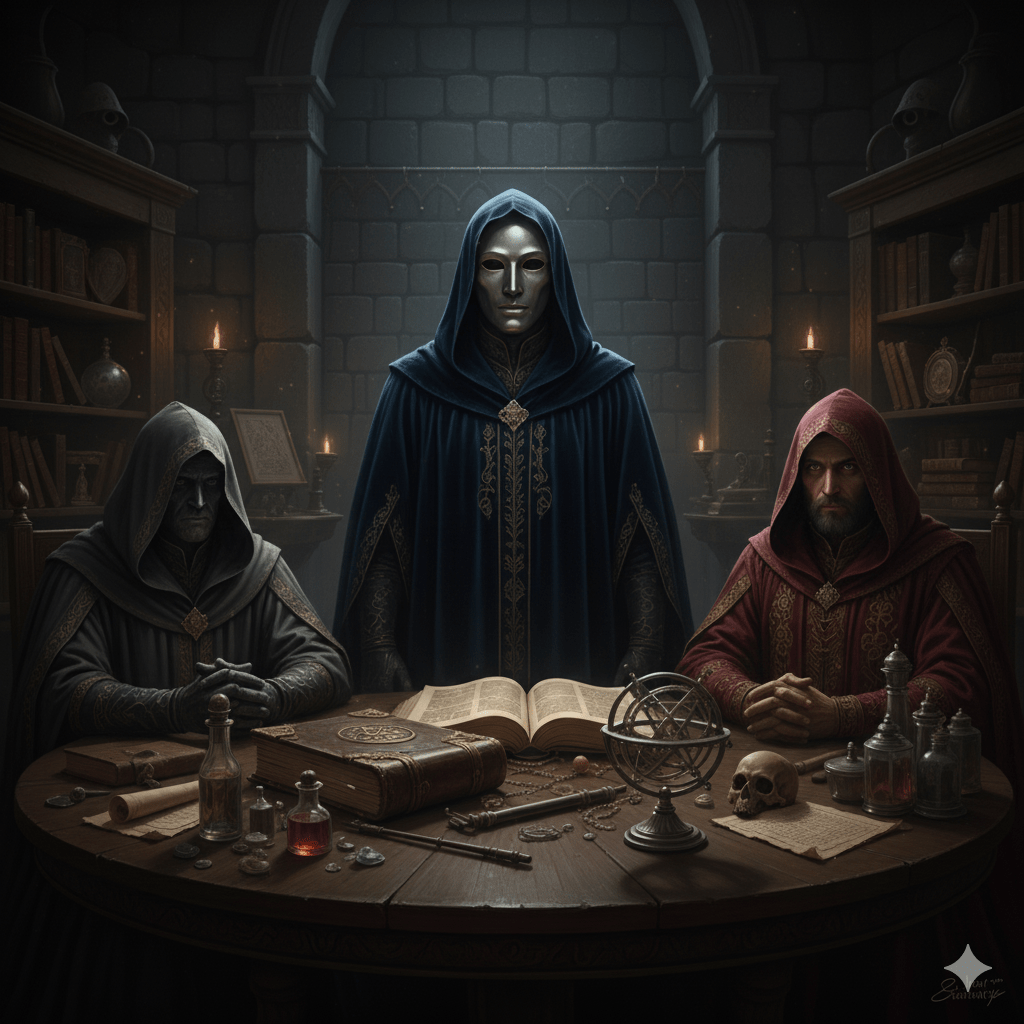
A crucial turning point in the formulation of these theories is found in the studies René Guénon dedicated to the subject. He published various articles in the anti-Masonic press, which modern readers can easily find in the reprint: AA VV, La polémique sur les “Supérieurs Inconnus”, Archè, Milan 2003. The volume also includes texts by other authors who dealt with the theme of the “Unknown Superiors”: Louis Dasté, Gustave Bord, Benjamin Fabre, Charles Nicoullaud, Papus, and Paul Copin-Albancelli.
Furthermore, there exists a monumental study by Louis de Maistre dedicated to the subject: L’Énigme René Guénon et les “Supérieurs Inconnus”. The author conducted extensive research into the sources used by the figures involved in the anti-Masonic polemic. In France, the journals leading this “meritorious civil battle” were: La Bastille, La France Antimaçonnique, Mysteria, and Revue Internationale des Sociétés Secrètes. Guénon wrote for these publications under the pseudonym “Le Sphinx.” The debate was primarily driven by conservative Catholic circles, but it also saw contributions from occultists like Guénon, and even former Masons and secular thinkers unsettled by the sectarianism of the lodges.
Discussions often centered on identifying the “Unknown Superiors”—the figures pulling the strings within Masonry, possibly through “unwarranted lodges.” These entities were sometimes identified as historical figures like Cagliostro or the Count of St. Germain; at other times, they were identified as the Jews, the Devil himself, or, more plausibly, a set of guiding ideas inspiring the logic of subversion. It was also hypothesized that “initiates” possessed the faculty to meet “in the astral”—an otherworldly, incorporeal dimension where they could coordinate their influence on society.
*
The spark for this reflection came from a study by Benjamin Fabre: Franciscus, Eques a capite galeato. Published in 1913, this essay was dedicated to the Marquis de Chefdebien, a high-ranking initiate whose Masonic career began during the preparatory phase of the French Revolution and continued under the Empire. Fabre’s study revealed how Napoleon believed he was controlling Masonry by placing his officers in the lodges, while in reality, it was Masonry that controlled the Emperor of the French!
This research highlighted the links between French lodges and Weishaupt’s “Bavarian Illuminati,” as well as hypotheses regarding a Jewish power center acting through Masonry.
*
From these premises begins the research of Louis de Maistre, who investigates the perennially open question of Guénon’s sources. The French philosopher deliberately left these in the shadows, both to fascinate the reader with his hermetic style and because he believed he was expressing “Traditional Truths” whose value was independent of the individual expressing them. While Guénon’s most ardent supporters view the work of the “Thinker of Blois” as the most important cultural event since the end of the Middle Ages, one must at least recognize Guénon as an authoritative guide through the “slippery ground” of occult history.
In these early articles, Guénon attacked Masonry in a style consistent with the journals he wrote for. However, in later works, he refined his judgment of the Freemasons, specifically criticizing the “modern deviations” of the lodges. Some have argued that Guénon served as a “Trojan Horse” within the Catholic world to spread a mindset more favorable to occultism. According to Louis de Maistre, however, this judgment is debatable, as Guénon’s overall critique of modernity closely aligns with that of traditionalist Catholic culture.
*
During his collaboration with La France Antimaçonnique, Guénon was in contact with an enigmatic character: Swami Narad Mani. This Hindu figure reportedly provided Guénon with documentation on Theosophy, which the philosopher used extensively in his corrosive essay against Madame Blavatsky’s thought system. While Narad Mani’s texts were not particularly original, some of his ideas influenced esoteric culture—notably the thesis of 33 lodges directed by an “Occult Committee.” This idea also appeared in the works of Leo Taxil: the 33 lodges through which the Luciferians supposedly governed the world. Indian sources also mentioned the Teshu Maru, a degenerate initiatic organization acting as a support for counter-initiation—hypotheses that fueled the imaginations of conspiracy theorists.
*
At this point, the investigation turns to Saint-Yves d’Alveydre, who provided Guénon with the inspiration for one of his most successful works: The King of the World. The idea of a subterranean kingdom ruled by utopian ideals was not new; it was later taken up by Ossendowski in his famous essay Beasts, Men and Gods. Ossendowski described the “King of the World” as the “Great Unknown,” an unsettling title that hinted at Antichrist-like qualities.
Saint-Yves, in turn, was inspired by Hardjji Scharipf Bagwandas, a Hindu whose style resembled that of Narad Mani. The relationship between Saint-Yves and Scharipf is documented from 1885, the year the Taxil affair erupted—a singular coincidence. In Saint-Yves’ work, we see glimpses of “infernal cities” and secret committees directing world events; the ingredients of the globalist power system were beginning to enter the intellectual imagination. Furthermore, Scharipf was likely an expert in the “Left-Hand Path,” the Tantric practice using sorcery, necromancy, and sexual magic to weaken the personality. These concepts found resonance in certain currents of the Jewish Kabbalah that would significantly influence the Masonic leadership.
*
Louis de Maistre identifies other sources feeding the legend of Agartha. The Austrian painter Alfred Kubin (1877–1959) painted infernal subjects depicting a world in dissolution and grip of violence. Kubin also wrote the novel Die andere Seite (The Other Side), describing a mysterious realm in Turkestan surrounded by a “Great Wall”—themes echoing those of Guénon and Ossendowski.
In The King of the World, Guénon argued that Satanism consisted precisely in identifying the “King of the World” with the princeps huiusmundi (the Devil)—the confusion between the luminous and the dark aspects. These ideas were widespread in the cultural debate of the time, linked to the sense of loss gripping the public during an era of burgeoning social and economic changes—changes now amplified to the nth degree by globalization.
*
The study also explores the eternal dilemma of conspiracy theorists: did Masonry emerge autonomously, or is it a creation of the Jewish community? The question likely remains unanswered. While Jewish influence is documented as far back as the 17th century in Cromwell’s entourage, Jews were few in the lodges of the early 18th century and were often viewed with suspicion by their own coreligionists.
What is documented is the spread of ideas from Jewish circles inspired by Sabbatai Zevi and Jacob Frank, who promoted a “Left-Hand Path” where vice and sin were the routes to salvation. Followers of these theories were organized into secret structures similar to Masonic ones, intending to offer the masses the “illusion of freedom” while enslaving them to a power far more cynical and despotic than the one they claimed to be escaping.
In the Kabbalah, contact with demonic forces grew in importance over time. Experts in this discipline were skilled in manipulating “psychic residues.” The application of these theories to the Masonic world is evidenced by the system of the “Élus Coëns” founded by Martinez de Pasqually in 1754. Even Cagliostro had contact in London with the Ba’al Shem, a disciple of Zevi.
*
Followers of Zevi and Frank acted as “missionaries of subversion,” infiltrating Masonic lodges and decisively conditioning their doctrines. Jacob Frank prefigured the advent of a “New World” characterized by a “Big Brother” and a “Female Messiah”—conceptions that bear frightening similarities to contemporary reality.
Madame Blavatsky’s Theosophical theories also played a major role; her theory of “Mahatmas” mirrors the idea of the “Unknown Superiors.” Theosophy influenced the Italian Risorgimento, particularly Mazzini and the Carboneria. Figures like Giacinto Bruzzesi and Adriano Lemmi were skilled in conducting these “occult operations.”
This “underground brainwashing” and psychic manipulation extended across continents, with the Theosophical Society serving as its visible, institutional face. This plan swept away all traces of “positive order,” implementing the purely destructive spiritual directives of Jacob Frank. This created a mechanism of social automation of which the masses were entirely unaware, governed by “initiates” acting as the missi dominici of the counter-initiation.
*
Conspiracy theorists often sought the geographical centers of counter-initiation in the East. Guénon believed Mongolia was a primary center for the irradiation of “malign influences,” and he even alluded to “diabolical towers” in the steppes of Central Russia.
The rise of the Communist regime in Russia seemed to confirm these theories. In the Russian context, Agwan Dorjiev, a Buddhist lama with influence in the Tsarist court (and later a victim of Stalinist purges), was suspected of being a vessel for Theosophical “universalist” ideas disguised as Buddhism.
Finally, Guénon appears to have been in contact with individuals working for the British Intelligence Service. He saw British imperialism as a powerful vehicle for the propagation of “democratic subversion.” A key figure in these British intrigues was Sir Basil Zaharoff, a cynical arms dealer and director armaments factory. Zaharoff—described by fascist intellectual Giovanni Preziosi as “the most mysterious man in the world”—was instrumental in fueling Balkan nationalisms that sparked the Great War. Zaharoff seems to have exerted some influence in inflaming the Balkan nationalisms that would eventually ignite the spark of the Great War.
Zaharoff’s early years are shrouded in deep mystery, and his sudden rise in the world of cosmopolitan business suggests that he was initiated into the most exclusive circles of occult forces…
The fascist intellectual Giovanni Preziosi himself, in a 1934 article, referred to Zaharoff as “the most mysterious man in the world.”
Zaharoff’s affairs also intertwine with those of Giuseppe Volpi, a Venetian businessman famous for founding the Venice Film Festival. Relying on the Banca Commerciale Italiana, Volpi managed flourishing trade in the Balkans, particularly in Serbia.
*
Conclusions
These figures appear to have operated according to very precise plans, alternately utilizing nationalism and internationalism to destabilize the old social order and usher humanity into the messianic era of globalism.
Conceptions of this kind were elaborated within Masonic circles, and Louis de Maistre also cites the work of the Calabrian Benedetto Musolino, who theorized a state founded on Mosaic and Talmudic principles: a true ante litteram prefiguration of Zionism!
Finally, Louis de Maistre’s study focuses on the importance of Guénon’s work within the realm of esotericism and occult history. The Master of Traditionalism is not usually taken seriously in academic circles—and, for his part, Guénon himself detested the university world. Nevertheless, the work of the thinker from Blois still offers a highly original perspective on occult history and suggests infinite avenues for further study; Louis de Maistre’s imposing essay is an excellent contribution in this regard.
##########
Louis de Maistre, L’Énigme René Guénon et les “Supérieurs Inconnus”. Contribution à l’étude de l’histoire mondiale “souterraine”, Archè, Milano 2004, pp.960
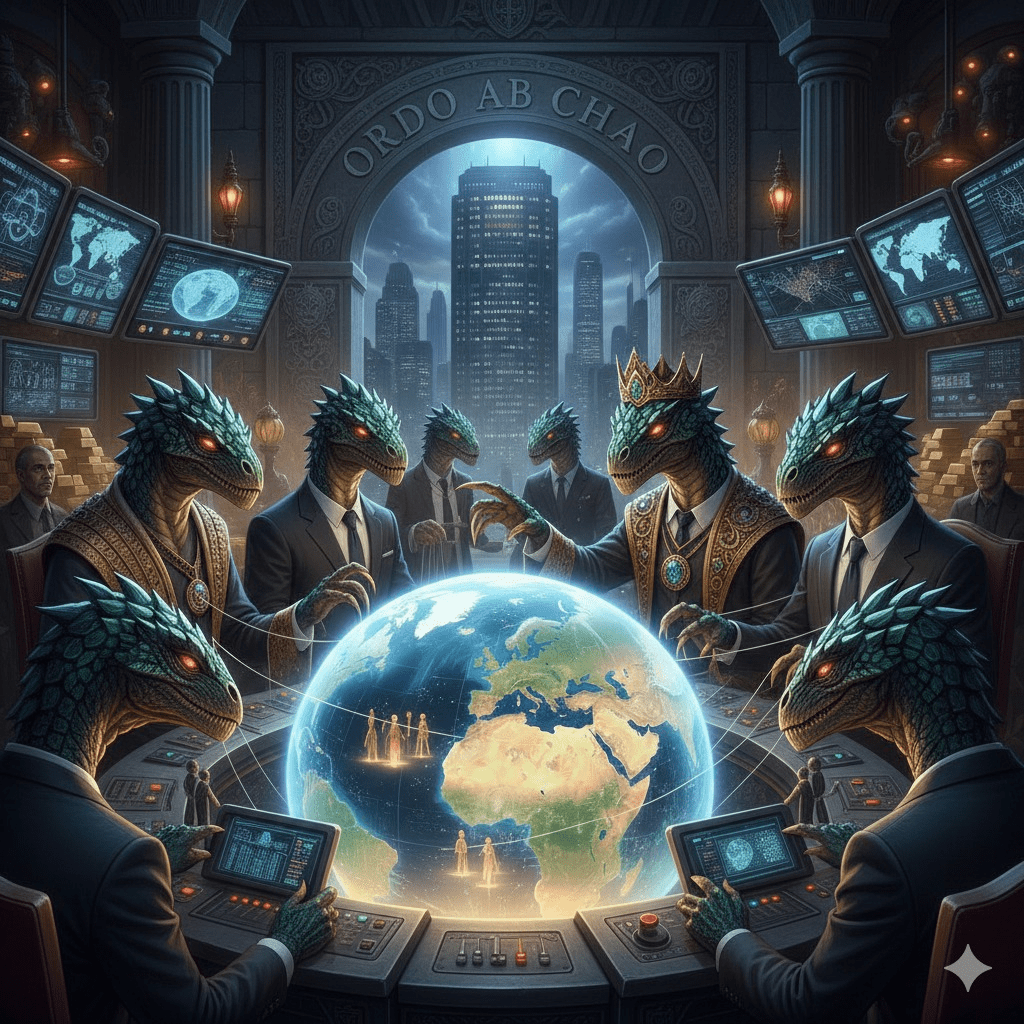
That globalization is the result of a carefully studied blueprint is certainly no mystery—at least for those willing to take the blinders off!
However, conspiracy theories have never been fully convincing. Conspiracy interpretations originated within the environment of counter-revolutionary Catholicism and were utilized by Nazi-Fascist propaganda; for this reason, such theories are generally discredited as being associated with religious or ideological fanaticism.
And yet, an analysis of globalism and its historical genesis leads necessarily to the conspiracy thesis, even if the phenomenon is observed from an absolutely secular and non-politicized point of view. This is the case with the English journalist David Icke, who in his youth was active in a left-wing ecological movement and who, reflecting on the increasingly absurd events of the late 20th century, began to study the globalist phenomenon, succeeding in catalyzing the interest of a young and very diverse audience across social and political backgrounds.
In his monumental essay, The David Icke Guide to the Global Conspiracy (and How to End It), the English author describes the globalist power system from its most distant origins: from the birth of religions to the formation of Masonic lodges, to the various power groups that control the financial and political world. Icke colors his theses with cultural elements inspired by esoteric, paranormal, and extraterrestrial theories…
Icke’s whimsical conjectures are likely at the root of the English scholar’s success with a mass audience: seasoning current events with Templars, Rosicrucians, Reptilians, and secret societies constitutes a call of undeniable interest. These elements may be fanciful, but considering the follies we see before our eyes, no path can be excluded in the search for an explanation for phenomena that escape all rational understanding.
Icke defines the emerging global power system as “Communist Fascism”! In truth, globalization, with its internationalist premises, is much more similar to communism; however, Icke’s expression is effective because it evokes the idea of a form of authoritarianism raised to the nth power, summarizing the most grim characteristics of totalitarian regimes.
Globalization seems to present all the ingredients of Satanism, and hypotheses regarding secret rituals taking place in Masonic lodges are certainly the pivot of the investigation into globalism: to secure the loyalty of adepts and suppress consciences, one cannot exclude that human sacrifice, cannibalism, and pedophilia take place within these lodges…
The global superpower group leading globalization defines itself by the term “Illuminati,” which echoes the name “Order of the Illuminati,” the 18th-century Masonic lodge that aimed to abolish the family and private property!
Highlights of Icke’s essay include chapters on the State of Israel and Zionist racism, the reconstruction of the attack on the Twin Towers (the official version of which wouldn’t even convince a child), the omnipresence of the Rothschild family in the history of the last 200 years, and the analysis of the Orwellian power structures of “democratic” states. Icke then exposes the most disturbing hypotheses of total control looming on the horizon: microchips applied to people, mind control, brain manipulation, chemtrails…
A significant part of Icke’s work is dedicated to the falsification and forgery of history, sometimes imposed by law as “state truth” and ingrained in the minds of the young by an education system that borders on psychological abuse of minors!
For those who do not wish to delve into a deep reading, Icke has also produced a three-DVD video set in which he presents his theses in a summarized and certainly more engaging form for the public. The DVD box set is accompanied by a booklet containing further scientific data: of particular interest are the hypotheses on the change of sexual identity, probably obtained through genetic manipulation and accompanied by feminist and homosexual propaganda whose obsessive hammering pales the propaganda apparatus of the great dictatorships of the 20th century! In particular, Icke notes how the furious attacks on male sexuality go hand in hand with the sex-change phenomena recently observed in some animal species and never recorded before. Furthermore, there is an increase in female births, whereas normally male births are slightly higher than female ones. The possibility that estrogens are being administered to the population through food and drink seems quite plausible. The increasingly feminized behavior of the male gender and the increase in breast cancer in women are suspicious elements to say the least: if two plus two equals four…
Proof of the validity of Icke’s theses is the fact that the “system” reacted furiously to his studies: the English journalist was dismissed as crazy and accused of defamation, spreading false news, and, naturally, of… racism (!?!). Evidently, he must have hit the mark…
In general, Icke’s work, even if it sometimes indulges in sensationalist elements, represents a valid contribution to the demystification of globalist ideology. It is comforting to observe that the “awakened” are beginning to appear from the most varied cultural backgrounds: perhaps it is the beginning of a revolution of awareness and common sense that can mark an important anthropological leap in quality for the humanity of times to come.
DAVID ICKE WEBSITE: David Icke – News
___________________________________
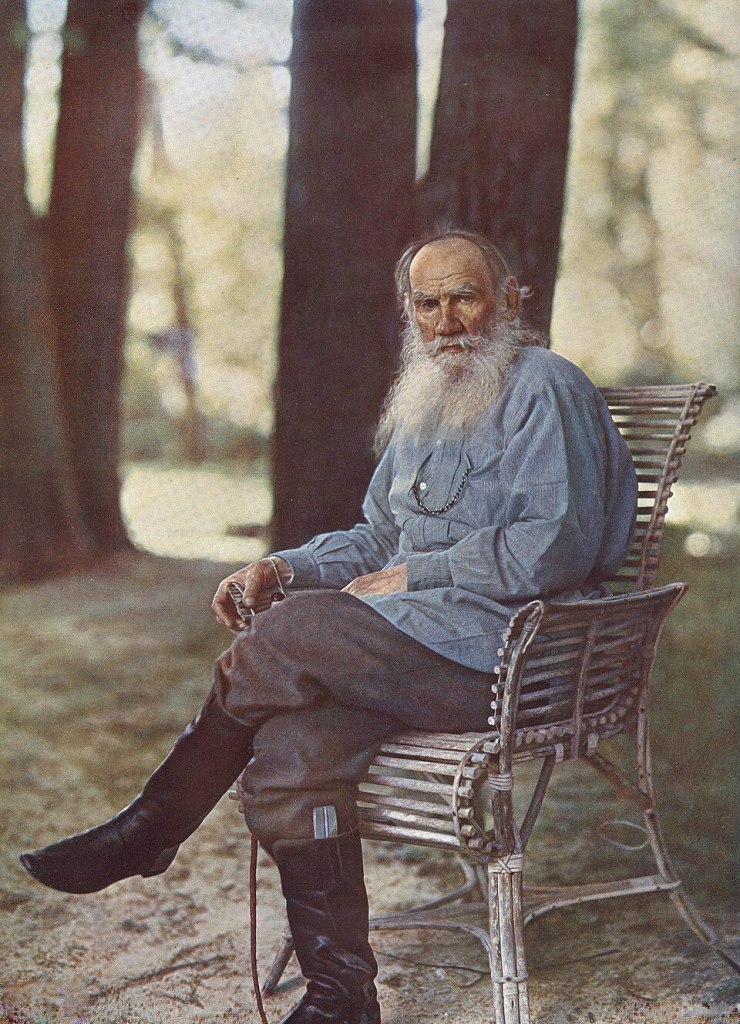
Leo Tolstoy is a writer whose greatness needs no introduction. The human condition is painted with extraordinary depth and power in War and Peace (1867). Contrary to what our contemporary image of Tolstoy might suggest, War and Peace is not a pacifist manifesto at all. The idle Russian bourgeoisie, immersed in balls, philosophical discussions, and socialites, is incapable of perceiving the gravity of the Napoleonic invasion; only the defeat and the horror of Austerlitz awaken the protagonists’ humanity, allowing them to understand the meaning of existence (both individual and collective) in a Russia threatened by destruction.
It is in this confrontation with necessity that Tolstoy is a genius: Napoleon is not an imaginary tyrant, but a man of flesh and blood; Russia is not a mere stage, it is life, it is the motherland. War is not a game, it is a necessity. Action, pain, commitment, sacrifice—far removed from balls and receptions. Here lies the Tolstoy one can admire without reservation: the one who captures man in the drama of his contradictions, who sees life as tragedy and not as mere material for moral lessons, and who idealizes neither the individual nor society, but observes them in their primary needs. To resist, to exist, to survive. To live.
Faced with this masterpiece, understanding the post-1870 Tolstoy appears almost impossible. His sudden conversion to a pacifism as absolute as it was abstract, his post-Christian moral doctrine, and his rejection of the Orthodox Church seem alien to the tragic experience he himself had masterfully represented. It is a stunning paradox: the author who understood that history and necessity impose sometimes terrible choices, the author who showed the inexorability of the confrontation with reality, becomes a moralist who imposes rules that ignore the concreteness of the world.
Applied to Russia, the pacifism of the Tolstoy of the late 1870s is absurd: a country repeatedly threatened in its very existence cannot afford “thin broths” of good intentions masked as abstract ethical ideals. Such an attitude can only be understood as the consequence of a terrible spiritual crisis: the shock of the destructive power of the individual and the unease regarding the violence it can generate within society.
In Anna Karenina (1878), we observe, almost experimentally, what triggers this crisis in Tolstoy’s soul: Anna’s vital and sexual passion for Vronsky. At first glance, the plot might seem banal: a young married woman falls in love with another man. “Big deal,” one might say. But Tolstoy transforms this banality into an existential catastrophe. Anna is certainly no naïve girl: she is an intelligent woman who knows the consequences of her actions, knows what it means to break conventions and live according to her own desire. And yet, tragedy manifests. Anna destroys those around her, destroys herself, and society reacts like an immune system imposing its sanctions.
In his late moral revolution, passion, vital force, and sexual desire become suspicious to Tolstoy—almost immoral. What the novelist had celebrated as a revelation of human life, the moralist now condemns. Sexuality, passion, and desire become sources of chaos and generate a violent response regardless of intent. Anna’s tragedy—the fact that she simply wanted to be happy and that this caused victims around and within her—becomes, for Tolstoy, the symbol of the danger of individual freedom. The moral solution proposed in his late writings, particularly in The Kingdom of God is Within You, consists of imposing an absolute curb on this freedom, subordinating the individual to a universal moral law, and denying violence and what vital desire can generate. Tolstoy denies freedom.
This transition from the novelist to the moralist represents a profound reversal: the genius capable of perceiving and rendering the complexity of life becomes the “guru” who simplifies what he had observed in all its richness ten years prior. Anna Karenina becomes a precursor laboratory for the moral doctrine that follows: the passion, error, and tragedy of the individual are the experiment that leads Tolstoy to want to uproot the destructive power of the individual and society.
Thus, the post-Anna Karenina Tolstoy loses the sense of the truly tragic. Life, previously a subject of infinite and nuanced observation, becomes a terrain for abstract and prescriptive morality. Passion, which he had understood and represented with such acumen, becomes suspect. The conflict between individual and society, between freedom and necessity, becomes a problem to be solved with abstract ethical principles, no longer a tragedy to be contemplated.
It is impossible, when reading Tolstoy, to separate admiration for the novelist from criticism of the moralist. War and Peace remains a pinnacle of the depth and complexity of the human condition, a monument to the greatness and fragility of man in the face of history. Anna Karenina, while admirable as a novel, anticipates the Tolstoy who rejects what he once celebrated: passion, desire, and irrepressible freedom. The radical pacifism and absolute morality of his late writings are the logical consequence of this flight from concrete life.
But Tolstoy’s moral fall is not limited to pacifism. His religious contradictions—denying the divinity of Christ, rejecting the Trinity, and transforming faith into a personal code—reveal a dangerous dissociation between art and doctrine. He claims to impart absolute ethical truths while pretending that the Gospel does not also speak of the resurrection of Jesus. He claims to found his morality on a Gospel that exists nowhere but in his own mind.
The post-Anna Karenina Tolstoy is a moralist who sacrifices the coherence and richness of human experience on the altar of a depersonalized and self-referential spirituality. Tolstoy remains an extraordinary and paradoxical author. However, the post-Anna Karenina Tolstoy—radical pacifist, absolute moralist, post-Christian—shows how a genius can lose his way, replacing the depth of the great artist’s gaze with a flat and abstract moral ideal, thereby losing contact with the complexity of life.
***
Luca Costa
***
Text translated from Italian into English by Google Gemini in 2026

