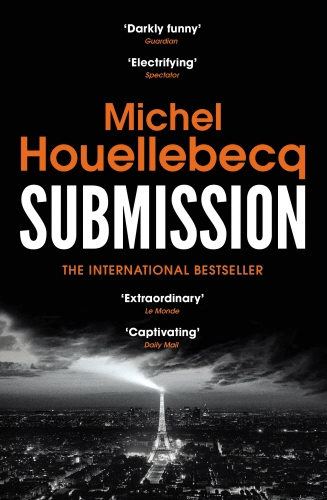
“Guénon as a reader of Nietzsche.” This is the interpretive key to Michel Houellebecq’s novel Submission, a book that fits into the tradition of the conte philosophique—a genre highly fashionable during the Enlightenment, effectively updated by the French writer to describe the scenario of moral decadence in 21st-century Europe. In Houellebecq’s conception, Nietzsche, the philosopher of the “death of God,” paved the way for Guénon, the esoteric thinker who converted to Islam. This theme is underscored by constant references to Huysmans, the murky Decadent writer who moved from frequenting circles of Satanism to converting to Catholicism. Contemporary reality seems consistent with this interpretation!
Naturally, all themes related to immigration are “incandescent” and difficult to handle, given that the Western ruling class still manages, incredibly, to hypnotize public opinion with anti-racist fairy tales. However, Houellebecq has already proven himself to be an author who doesn’t mince words, and once again, he manages to provoke in a way that is anything but cliché.
The Portrait of Western Decline
The novel is not particularly gripping in terms of narrative, as the plot is very simple; its essential purpose is to outline the current mindset of modern Westerners. Particularly successful is the description of the university environment—from which one would expect the spark of critical culture, but which has instead become a factory of flattening and homogenization. This is the inevitable result of decades of leftist cultural hegemony that has stifled free intelligence.
Through literary references and citations, the author describes a society that has:
- Nothing to believe in.
- Nothing to hope for.
- Nothing to fight for.
In this desolate void, characterized by the hypocrisies of socialists, liberals, and nationalists, the Muslim party cuts through like a knife through butter. It easily conquers power by allying with the Left, which, for the sake of defeating the nationalists, is willing to sell off the most precious of its “family jewels”: feminism.
Anthropological Mutations
In fact, although the novel is set against the grand geopolitical backdrop of mass migration and the Islamic advance, Houellebecq’s true objective is to discuss the profound anthropological mutations occurring in the relationships between the sexes. It is in these pages that the author unleashes a sarcasm that makes certain passages truly memorable. Ultimately, the protagonist himself—whose only interests are easy, low-commitment sexual flings—accepts conversion to Islam for the prospect of having a harem of docile, devoted concubines at his service, as well as industrious and diligent housewives.
A Realistic Future?
Many wonder if the future described by Houellebecq is realistic. It is certainly not impossible that Europe could be almost entirely colonized by Islamic populations, given the surrender Europeans have shown in recent years. However, one must wonder if Western culture—characterized by a cultural sophistication of a richness and variety unparalleled in the world—can truly be erased in such a short time.
Furthermore, in the pages of Submission, there are scant mentions of the relationships between France, Europe, and the rest of the world. References to the “Jewish question” are also quite evanescent: an Islamized Europe would be unsettling for Zionism, and the disappearance of the State of Israel would remove the very raison d’être of modern Western democracies.
Conclusion
Indeed, the Islamization of France in the novel is described primarily in its social implications:
- The return of patriarchy.
- The elimination of female labor (resulting in the disappearance of unemployment).
- More stable family institutions establishing greater social cohesion, leading to a drastic drop in crime.
Rather than “Islamization,” one might speak of a common-sense political program to build a more human society; but evidently, this is not the case for the subhuman masses of the West who grant their consensus to market democracies. And perhaps that is precisely why Houellebecq’s book is so frightening.
***
Michel Houellebecq, Submission, Penguin Books, 2016