
THE ARISTOTELIANS (NOT THE CATHOLICS) WERE AGAINST GALILEO
************
The story of Galileo Galilei is often recounted as a clash between science and religion. It is a compelling narrative, undoubtedly, but it is useless for understanding what actually happened.
If one carefully observes the 17th-century intellectual context, a very different reality emerges: the true conflict was not between Galileo and Catholicism (Galileo, after all, was a Catholic), but between two radically different ways of conceiving scientific research: Aristotelianism and modern physics, which had just been founded by Galileo himself.
On one hand, there was the new mathematical and experimental method that Galileo wanted to establish; on the other, the tradition of Aristotelian natural philosophy, which at the time was still dominant in universities and European learned culture. The university chairs of the Catholic world—among the continent’s primary cultural institutions—were inevitably occupied by illustrious Aristotelians. The result was that the epistemological conflict between the latter and Galileo was transformed, through a series of historical and political circumstances, into a clash between two irreconcilable visions of research and scientific/academic dissemination.
The Weight of Aristotle’s Legacy
It is not easy for us to grasp how heavy the legacy of Aristotle was in European culture. For nearly two thousand years, his philosophy had constituted the theoretical framework for the study of nature (and practically everything else subject to study). Medieval and Renaissance universities had organized their curricula around Aristotle, and thinkers like Thomas Aquinas had dedicated their lives to integrating Aristotelianism into Christian theology—partly to reclaim it from the hegemony of the Arab/Muslim world (which had inherited Aristotle by taking possession of the Eastern Roman Empire, i.e., the Greek world).
This does not mean that Christianity was subordinate to Aristotle’s philosophy, but the categories that provided access to understanding the world were (and had to be) Aristotelian. To criticize Aristotle did not simply mean attacking this or that scientific theory; it meant questioning the conceptual foundations upon which most of European university teaching was based. It meant questioning the entire European academic world.
Qualitative vs. Quantitative Science
Aristotelian physics was a coherent system, if you will, but totally different from modern physics. Today we wouldn’t even call it “physics,” but rather a blend of philosophical speculation and profound observation of the world and the cosmos.
It was a qualitative science, not a mathematical one. Natural phenomena were explained through categories such as form, matter, cause, and end, and through qualities like heaviness and lightness. The movement of bodies was interpreted in light of the idea of “natural places”: heavy objects tended toward the center of the world, while light ones tended upward. Within this theoretical framework, it was believed that the speed of a falling body was proportional to its mass (which is absurd) and that movement always required a continuous cause to sustain it. It was a way of reasoning that privileged conceptual analysis and philosophical consistency over experimental and quantitative measurement.
The Role of Mathematics
Within this academic world steeped in Aristotelianism, mathematics occupied an ambiguous position. The Greek tradition had produced extraordinary mathematicians like Euclid, Pythagoras, and Archimedes, but natural philosophers believed that mathematics served only to describe abstract entities, not concrete physical reality. Physics, according to this perspective, was supposed to study real bodies and their qualities, while mathematics dealt with ideal figures and formal relations.
Even astronomy was often considered a mere calculation useful for predicting planetary positions, not an exact description of the structure of the cosmos. Even the great astronomical system developed by Ptolemy was seen more as a device intended to “save the appearances” (explain strange phenomena) rather than a true physical theory about the reality of the cosmos.
The Galilean Revolution
Without keeping all of this in mind, the radical nature of the Galilean revolution is incomprehensible. When Galileo asserts that the “book of nature” is written in mathematical language, he is not simply proposing a new theory. He is changing the rules of the game; he is revolutionizing science at its roots, overturning empirical and speculative knowledge at the same time.
For him, mathematics is no longer the abstract world of calculations; it is the very language of physics. And of the universe (for the first time with Galileo, we can speak of a “universe” precisely in the name of mathematics and a physics made of math: uni-verse, one, a single world where the same laws apply everywhere).
This transformation is clearly visible in his research on dynamics. By studying falling bodies and projectile motion, Galileo introduced a quantitative description of movement and showed that natural phenomena can be expressed through precise mathematical relationships.
The Thought Experiment
But Galileo did not stop at introducing equations. He also developed a new methodological tool: the experience or thought experiment (esperimento mentale).
Let’s take an example: he criticized the Aristotelian idea that heavier bodies fall faster (with a speed proportionally dependent on their mass). Galileo imagined two objects, one heavy and one light, and asked what would happen if they were tied together during the fall. If the Aristotelian theory were correct, the light body should slow down the heavy one; but at the same time, the overall system, being heavier, should fall faster than the heavy body alone. The theory thus generates an unacceptable contradiction. This type of reasoning demonstrates a new use of logic and scientific imagination: the scientist’s mind becomes a literal laboratory where experiments are conducted and ideal situations are explored to test the consistency of theories.
The Telescope and the Crisis of the Senses
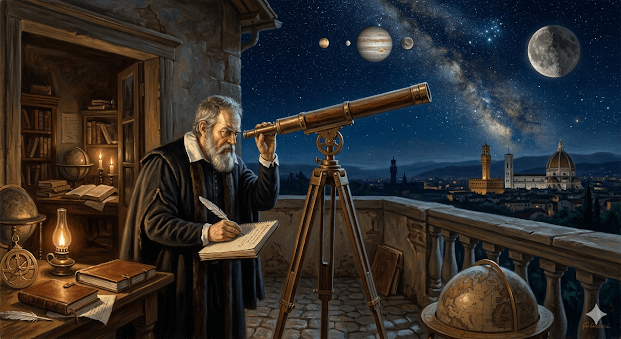
The refinement of the telescope further strengthened this methodological revolution. When Galileo observed the lunar mountains, sunspots, and the moons of Jupiter, he demonstrated that the heavens were not a perfect and immutable realm, as described by Aristotelian cosmology. However, we must remember that optical instruments were then a new and imperfect technology. Many scholars distrusted the images produced by lenses, fearing they might distort reality. From their perspective, it was not entirely unreasonable to suspect that the telescope might generate illusions. The problem was not simply accepting or rejecting an empirical fact; it was deciding whether an artificial instrument could be considered a reliable extension of the senses.
The Epistemological Asymmetry
The conflict between Galileo and his adversaries took place on much deeper ground than a simple religious or astronomical dispute. It was a matter of establishing whether nature should be studied through qualitative categories and philosophical arguments, or through measurements, instruments, and mathematical models.
The Aristotelians, who demanded solid proof from Galileo, had never felt obliged to mathematically prove Aristotle’s own theses because, within their epistemological framework, mathematics was not a criterion for physical truth. When Galileo introduced mathematics as the foundation of physics, he implicitly demanded that all theories about nature be judged and grounded according to a new standard. This gave rise to an asymmetry that modern historians should find surprising: the Aristotelians demanded mathematical demonstrations from Galileo that they had never required of their own master.
The Paradox of the Tides
In this scenario, the question of heliocentrism takes on a particular significance. The system proposed by Copernicus represented a challenge to traditional cosmology, but in the early 17th century, a definitive proof of the Earth’s motion did not yet exist. Galileo was convinced he had found such proof in his explanation of the tides.
He believed the ebb and flow of the tides were caused by the combination of the Earth’s two movements: its daily rotation and its annual revolution around the Sun. In this theory, the oceans behaved like water in a vessel being accelerated and decelerated. The explanation was elegant, but incorrect. Today we know that tides are primarily due to the gravitational pull of the Moon and, to a lesser extent, the Sun, and that a complete quantitative theory would only become possible with Newtonian dynamics. The historical paradox is that Galileo was right about heliocentrism but wrong about his primary proof, while Kepler had correctly intuited the Moon’s role in the tides.
Academia vs. Innovation
The facts show how reductive it is to view the disputes over heliocentrism as a simple opposition between science and religion. Many men of the Church were scientists or mathematicians, and the Church itself was by no means hostile to scientific research or the theories of Copernicus, Galileo, or Kepler.
The problem was that the cultural institutions of the time, including universities and Catholic scientific academies, were deeply dominated by and steeped in Aristotelian philosophy. Consequently, the methodological conflict between Galileo and the Aristotelians found a powerful (and partly involuntary) political amplifier in the institutional structure of the Church. It was not Catholicism as such that clashed with Galileo, but an Aristotelian academic culture that, at the time, frequently overlapped with ecclesiastical authority.
The Legacy of the Revolution
History would prove how radical—and genius—the paradigm shift introduced by Galileo truly was. Within decades, Kepler’s laws and Newton’s gravitational theory would definitively transform physics into a mathematical science. What appeared to most in the early 1600s as a daring innovation became the very foundation of modern science.
The true significance of the Galilean revolution lies not in his support for heliocentrism, but in his inauguration of a new way of questioning nature: measuring, mathematizing, experimenting, and, when necessary, imagining experiments that the mind can conduct even before they reach the laboratory. He understood that there is an actual correspondence between our mental experiences and the laws of the universe—an astonishing miracle that alone suggests Galileo was far closer to the essence of Christianity than all the Aristotelians combined.
Seen from this perspective, the Galileo affair is no longer the story of a man of science fighting religion. It is the story of an epochal cataclysm in Western culture: the historical moment where mathematics and experimental physics merged to become the language through which humanity seeks to understand the workings of what we can finally call the Universe.
The drama arose from the fact that this revolution occurred while the great cultural institutions were still saturated with the old Aristotelian paradigm. And the Aristotelians did not want to lose face—nor their jobs. Within that tension between two ways of understanding the world lies the true heart of the story of the greatest scientist of all time: Galileo Galilei.
text translated from Italian into English by Google Gemini – 2026

