
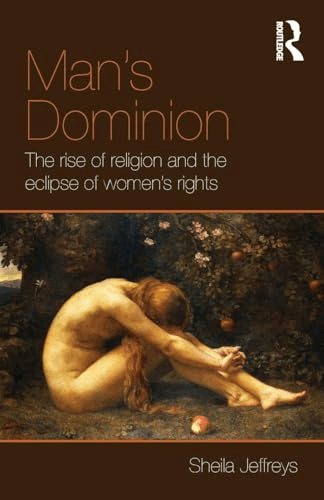
One of the most interesting aspects of the contemporary ideological debate is the relationship between feminist thought and religions. Feminism, which serves as the state ideology in Western democracies, presents clear points of friction with traditionally defined religious morality.
Sheila Jeffreys’ essay, Man’s Dominion: The Rise of Religion and the Eclipse of Women’s Rights, is dedicated to this theme. The author teaches political science at the University of Melbourne and is one of the most authoritative voices in global feminism; reading her book allows us to get a sense of “what’s cooking”…
Jeffreys traces several key points of the issue in recent history. Between the 1960s and the 1980s, the conviction had formed that religions had entered a phase of irremediable decline, and leftist ideologies utilized traditional laicist and anti-clerical arguments in their publications. During that period, feminists achieved their most brilliant successes across almost the entire Western world: divorce and abortion. The propaganda campaigns for feminist demands were marked by a frontal collision with Christian Churches, from which the latter emerged practically disintegrated.
Starting in the 1990s, things began to change: the massive arrival of migrants from Muslim countries in the West forced authorities to recognize lifestyles—and sometimes grant them legal standing—that would be considered inadmissible for citizens of Western nations.
In fact, within Islamic communities living in the West, the condition of women has not undergone assimilation into that of Western women; rather, it has remained substantially tied to the customs of their places of origin. The Left, which governs almost undisturbed throughout the Western world, imposing the feminist agenda through gender quotas, has found itself managing the relationship with immigrant communities (largely Muslim) and having to choose between indulgence toward these populations and the demands of female emancipation. De facto, two parallel societies have been created: that of the natives, where males are in a state of legal minority, and that of the immigrants, where patriarchy has not even been scratched.
Since the reproduction rate of immigrant populations is overwhelming compared to that of native Western populations, it is easy to predict that within one or two generations, feminism will end up end up on the ash heap of history…
Jeffreys also laments the difficulty of monitoring the condition of women within families and communities, implying that, in the name of female emancipation, she would like to tear the right to privacy to shreds…
Jeffreys herself reports with alarm that criticizing the condition of women in Islam is labeled as racism even within universities. Thus, we frequently see the staid and pompous academic culture of progressive tyrannies becoming a victim of its own anti-discrimination ideology!
Also disturbing the dreams of feminists are cultural currents and congregations within the Christian world that hold a conception of women that appears unacceptable to them. And it doesn’t end there: even within the Jewish religion, there are sects that assign social and family roles to women that “neo-suffragettes” consider retrograde.
A large part of the book is dedicated to an aspect shared by Islam and specific currents of North American religious landscape: polygamy. This, apparently, is the bitterest pill for feminist thinkers. Polygamy is considered intrinsically harmful to women; specifically, the idea of a male having a harem at his disposal to satisfy his sexual desires is a true nightmare for Jeffreys. In the United States and Canada, polygamy among Mormons—officially abandoned in 1890—is de facto practiced in some communities, and in recent years there have been court rulings declaring such situations legitimate.
It should be noted that Jeffreys only considers monotheistic religions, even though all other religions represent the majority of humankind—especially considering that practiced Christianity is now a minority. Obviously, this focus on monotheism stems from the fact that the Biblical conception of God has decisively shaped Western history, but it is a surprising attitude, to say the least, for someone who claims daily to want to put Western culture… on trial! The fact that the West was pagan before it was Christian is not even taken into consideration.
However, the feminist point of view is in evident embarrassment when forced to take a stance on religion. Let’s summarize the terms of the issue:
- Judaism: Orthodox Jews maintain a rigid distinction of gender roles and sometimes, in certain sects, practice polygamy or even concubinage, following the example of the patriarch Abraham joining with the slave Hagar.
- Christianity: Although in the past Christian morality decisively opposed feminism and “homosexualism,” today—after having disastrously lost those battles—Christian Churches have predominantly moved to the opposing camp. However, substantial pockets of dissent remain in the Christian world, and the theme of Mormon polygamy is seen by feminists as a “loose cannon.”
- Islam: It is traditionally the most “masculinist” religion; it regularly permits polygamy and the use of the veil to cover the female face.
Furthermore, all religions have traditionally condemned abortion and homosexuality, albeit with different nuances.
Jeffreys’ conclusion is that a vigorous secularist offensive against all religions is needed, as she believes religions have regained strength as a smokescreen for lost “male privileges” (to get an idea of what these “male privileges” are, a reading of Warren Farrell’s The Myth of Male Power is recommended).
The question is: can leftist ideologies afford such a strategy?
It is well known what Judaism signifies for the Left; the Muslim masses in Europe, funded by a flood of petrodollars, bring millions of votes to progressives; Christian Churches are now reduced to the role of a breeding ground for the progressive political class. Moreover, even from a conceptual point of view, the God of the Bible is nothing more than the “feminine and whining” mentality that generates the ideology of victimhood.
In short, an attack on the “Religions of the Book” means, for feminists, biting the hand that feeds them!
Not only that: Jeffreys also complains that the most influential atheist and agnostic intellectuals in the current cultural landscape have the flaw of… being male!!!
These are issues that are not easily solved for feminist thinkers firmly ensconced in Western universities and institutions.
Reading books of this kind is particularly disturbing and leaves a bad taste in the mouth because it shows the level of ideological paranoia established by politically correct authoritarianism. But the good news lies in the macroscopic contradictions generated by the system itself—contradictions upon which opponents of the globalist regime can work fruitfully to build an alternative and instill hope in a new world.
***
Sheila Jeffreys, Man’s Dominion: the Rise of Religion and the Eclipse of Women’s Rights, Routledge 2011, p.232
 LITTERAE - Homepage