
Afterlife Beliefs
____________
The Victrix publishing house performs a commendable service in disseminating classical culture; a truly significant title in its catalog is Le credenze d’oltretomba nelle opere dell’antichità classica (Afterlife Beliefs in the Works of Classical Antiquity) by Carlo Pascal. First published in 1911, the book remains a useful guide today for surveying the sources regarding conceptions of the afterlife in the ancient world.
The general conception of the afterlife in the Western world is essentially shaped by the descriptions in the Divine Comedy, yet Dante was himself deeply indebted to the depictions of the underworld provided by ancient literature. Furthermore, references to the afterlife in the Bible are quite vague in both the Old and New Testaments, whereas the pagan world appears to have held more precise ideas about the otherworldly realm.
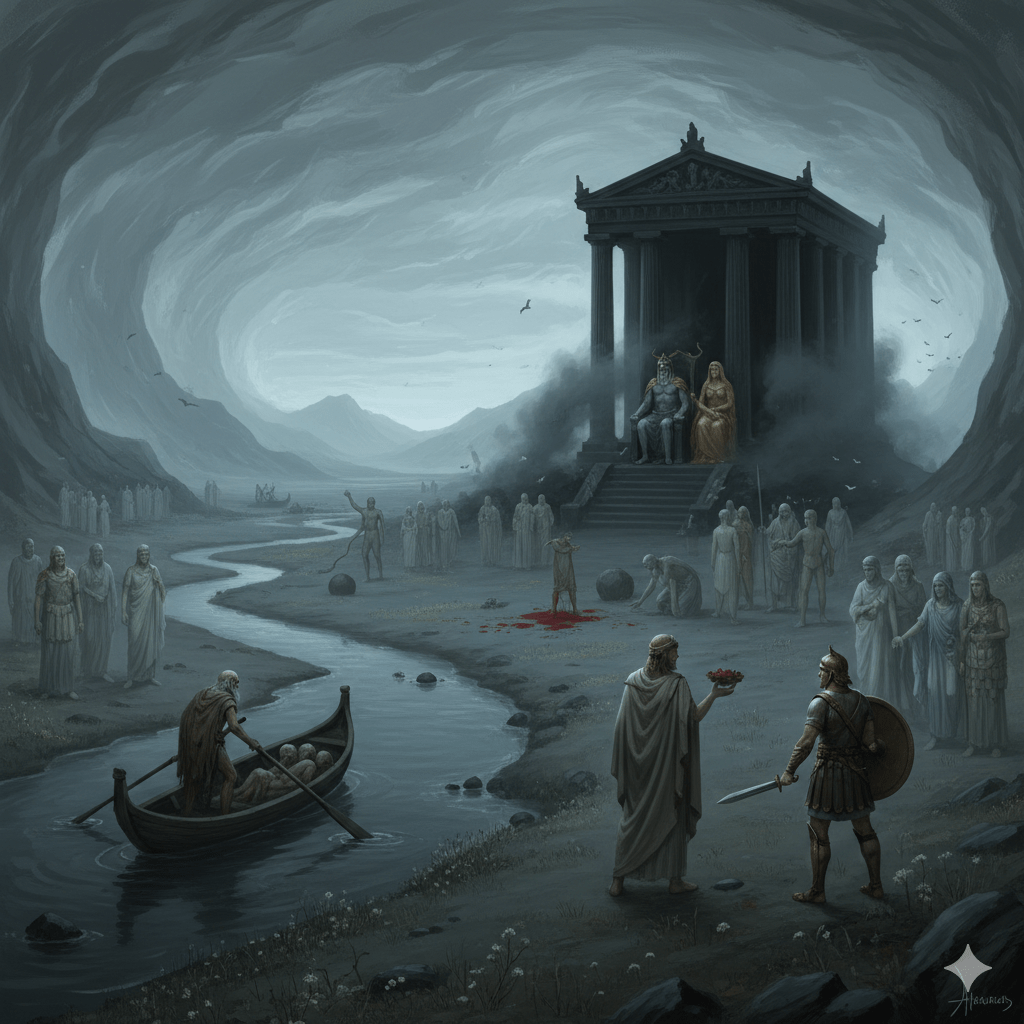
Among the oldest recorded customs is the offering of crowns to the dead, as if they were victors in an ideal race of life: from this concept emerged a sense of immortality that assimilated men to the gods. Ancient literature, from Homeric times onward, describes the Realm of the Dead—initially with distressing tones (such as the shade of Achilles in the Odyssey), and later with hopes of happiness that find their greatest expression in Virgil’s “Elysian Fields.” Generally, one observes that in the earliest stages, the abode of the dead is perceived as a shadowy and indistinct place; over time, clearer conceptions emerge. The posthumous condition appears increasingly linked to the deceased’s conduct during life, with corresponding rewards and punishments. This framework transitioned into Christian views of the afterlife, eventually leading to the medieval development of a temporary place of suffering that prepares souls for Heaven: Purgatory.
Pascal’s study examines the locations and figures of the underworld: from the infernal rivers to the Furies, from the Etruscan-origin demon Charon to the judge Minos. Pascal consistently references primary sources, including not only great literary works but also the philosophical doctrines of various ancient schools, as well as sepulchral inscriptions and Orphic fragments, identifying interesting connections with Jewish and early Christian apocalyptic literature. This entire heritage of the imagination would later be masterfully utilized by Dante Alighieri.
In ancient Rome, the conception of the afterlife also had political reflections through the deification of emperors (apotheosis). Ancient writers recount that numerous prodigies occurred upon the death of Caesar, and rumors spread that he had been taken up to heaven among the gods. The Roman ruling class saw the deification of the emperor as an opportunity to strengthen the sense of the state, to the extent that Augustus himself was depicted with a halo—which would later become the hallmark of sanctity in Christianity. Once again, we see how the new religion integrated itself into an already well-defined system of values and symbolic references.
It is to be hoped that the reissue of Pascal’s book paves the way for the rediscovery of his other works on ancient religious history and Medieval Latin literature, of which Pascal was a meticulous scholar.
******
Carlo Pascal, Le credenze d’oltretomba nelle opere letterarie dell’antichità classica, Victrix, Forlì 2006, pp.266
 LITTERAE