
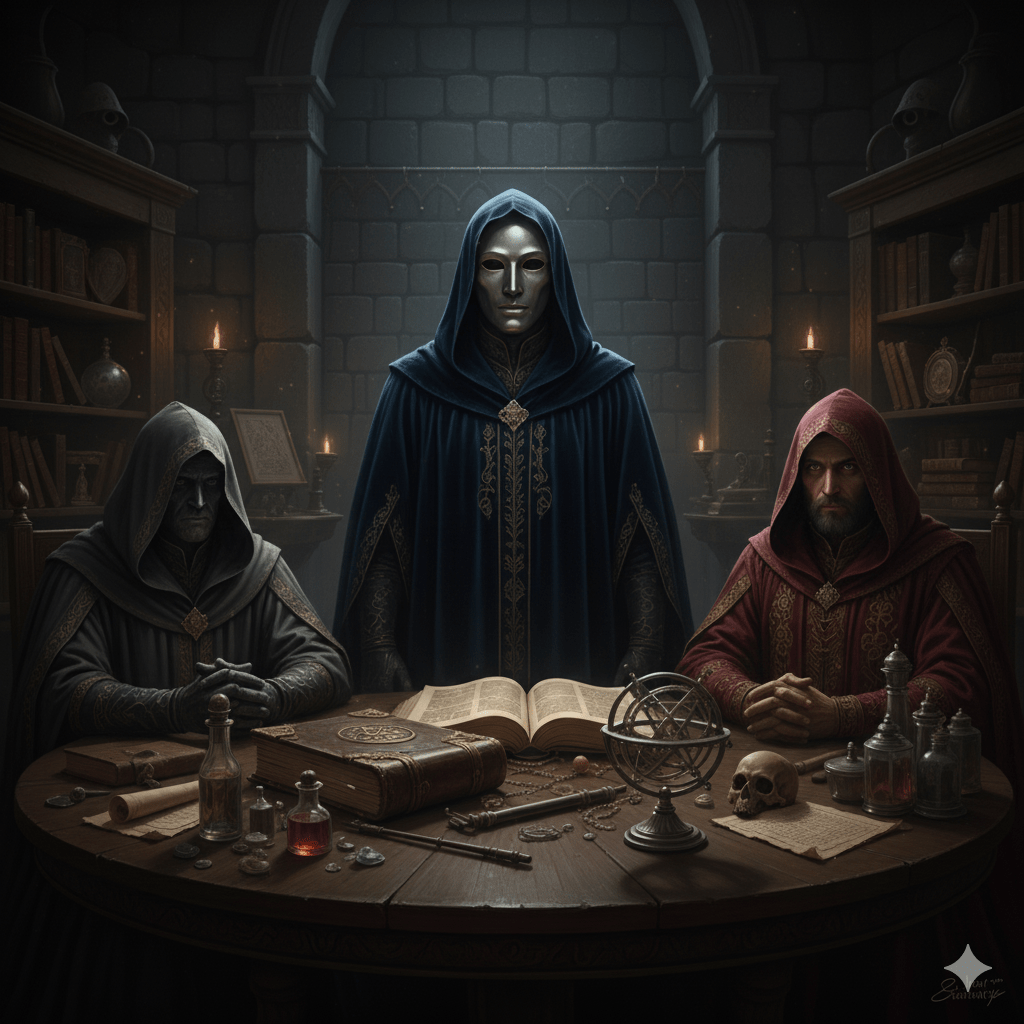
The Unknown Superiors
__________________________
Conspiracy theories investigating the “absolute evil” of globalization have a long history, stretching from the late 18th-century theories of Abbé Barruel to contemporary globalist agendas.
A crucial turning point in the formulation of these theories is found in the studies René Guénon dedicated to the subject. He published various articles in the anti-Masonic press, which modern readers can easily find in the reprint: AA VV, La polémique sur les “Supérieurs Inconnus”, Archè, Milan 2003. The volume also includes texts by other authors who dealt with the theme of the “Unknown Superiors”: Louis Dasté, Gustave Bord, Benjamin Fabre, Charles Nicoullaud, Papus, and Paul Copin-Albancelli.
Furthermore, there exists a monumental study by Louis de Maistre dedicated to the subject: L’Énigme René Guénon et les “Supérieurs Inconnus”. The author conducted extensive research into the sources used by the figures involved in the anti-Masonic polemic. In France, the journals leading this “meritorious civil battle” were: La Bastille, La France Antimaçonnique, Mysteria, and Revue Internationale des Sociétés Secrètes. Guénon wrote for these publications under the pseudonym “Le Sphinx.” The debate was primarily driven by conservative Catholic circles, but it also saw contributions from occultists like Guénon, and even former Masons and secular thinkers unsettled by the sectarianism of the lodges.
Discussions often centered on identifying the “Unknown Superiors”—the figures pulling the strings within Masonry, possibly through “unwarranted lodges.” These entities were sometimes identified as historical figures like Cagliostro or the Count of St. Germain; at other times, they were identified as the Jews, the Devil himself, or, more plausibly, a set of guiding ideas inspiring the logic of subversion. It was also hypothesized that “initiates” possessed the faculty to meet “in the astral”—an otherworldly, incorporeal dimension where they could coordinate their influence on society.
*
The Influence of Benjamin Fabre
The spark for this reflection came from a study by Benjamin Fabre: Franciscus, Eques a capite galeato. Published in 1913, this essay was dedicated to the Marquis de Chefdebien, a high-ranking initiate whose Masonic career began during the preparatory phase of the French Revolution and continued under the Empire. Fabre’s study revealed how Napoleon believed he was controlling Masonry by placing his officers in the lodges, while in reality, it was Masonry that controlled the Emperor of the French!
This research highlighted the links between French lodges and Weishaupt’s “Bavarian Illuminati,” as well as hypotheses regarding a Jewish power center acting through Masonry.
*
René Guénon: The Hermetic Guide
From these premises begins the research of Louis de Maistre, who investigates the perennially open question of Guénon’s sources. The French philosopher deliberately left these in the shadows, both to fascinate the reader with his hermetic style and because he believed he was expressing “Traditional Truths” whose value was independent of the individual expressing them. While Guénon’s most ardent supporters view the work of the “Thinker of Blois” as the most important cultural event since the end of the Middle Ages, one must at least recognize Guénon as an authoritative guide through the “slippery ground” of occult history.
In these early articles, Guénon attacked Masonry in a style consistent with the journals he wrote for. However, in later works, he refined his judgment of the Freemasons, specifically criticizing the “modern deviations” of the lodges. Some have argued that Guénon served as a “Trojan Horse” within the Catholic world to spread a mindset more favorable to occultism. According to Louis de Maistre, however, this judgment is debatable, as Guénon’s overall critique of modernity closely aligns with that of traditionalist Catholic culture.
*
Enigmatic Figures: Swami Narad Mani
During his collaboration with La France Antimaçonnique, Guénon was in contact with an enigmatic character: Swami Narad Mani. This Hindu figure reportedly provided Guénon with documentation on Theosophy, which the philosopher used extensively in his corrosive essay against Madame Blavatsky’s thought system. While Narad Mani’s texts were not particularly original, some of his ideas influenced esoteric culture—notably the thesis of 33 lodges directed by an “Occult Committee.” This idea also appeared in the works of Leo Taxil: the 33 lodges through which the Luciferians supposedly governed the world. Indian sources also mentioned the Teshu Maru, a degenerate initiatic organization acting as a support for counter-initiation—hypotheses that fueled the imaginations of conspiracy theorists.
*
Agartha and the King of the World
At this point, the investigation turns to Saint-Yves d’Alveydre, who provided Guénon with the inspiration for one of his most successful works: The King of the World. The idea of a subterranean kingdom ruled by utopian ideals was not new; it was later taken up by Ossendowski in his famous essay Beasts, Men and Gods. Ossendowski described the “King of the World” as the “Great Unknown,” an unsettling title that hinted at Antichrist-like qualities.
Saint-Yves, in turn, was inspired by Hardjji Scharipf Bagwandas, a Hindu whose style resembled that of Narad Mani. The relationship between Saint-Yves and Scharipf is documented from 1885, the year the Taxil affair erupted—a singular coincidence. In Saint-Yves’ work, we see glimpses of “infernal cities” and secret committees directing world events; the ingredients of the globalist power system were beginning to enter the intellectual imagination. Furthermore, Scharipf was likely an expert in the “Left-Hand Path,” the Tantric practice using sorcery, necromancy, and sexual magic to weaken the personality. These concepts found resonance in certain currents of the Jewish Kabbalah that would significantly influence the Masonic leadership.
*
The Shadow of Globalization
Louis de Maistre identifies other sources feeding the legend of Agartha. The Austrian painter Alfred Kubin (1877–1959) painted infernal subjects depicting a world in dissolution and grip of violence. Kubin also wrote the novel Die andere Seite (The Other Side), describing a mysterious realm in Turkestan surrounded by a “Great Wall”—themes echoing those of Guénon and Ossendowski.
In The King of the World, Guénon argued that Satanism consisted precisely in identifying the “King of the World” with the princeps huiusmundi (the Devil)—the confusion between the luminous and the dark aspects. These ideas were widespread in the cultural debate of the time, linked to the sense of loss gripping the public during an era of burgeoning social and economic changes—changes now amplified to the nth degree by globalization.
*
Subversion and Counter-Initiation
The study also explores the eternal dilemma of conspiracy theorists: did Masonry emerge autonomously, or is it a creation of the Jewish community? The question likely remains unanswered. While Jewish influence is documented as far back as the 17th century in Cromwell’s entourage, Jews were few in the lodges of the early 18th century and were often viewed with suspicion by their own coreligionists.
What is documented is the spread of ideas from Jewish circles inspired by Sabbatai Zevi and Jacob Frank, who promoted a “Left-Hand Path” where vice and sin were the routes to salvation. Followers of these theories were organized into secret structures similar to Masonic ones, intending to offer the masses the “illusion of freedom” while enslaving them to a power far more cynical and despotic than the one they claimed to be escaping.
In the Kabbalah, contact with demonic forces grew in importance over time. Experts in this discipline were skilled in manipulating “psychic residues.” The application of these theories to the Masonic world is evidenced by the system of the “Élus Coëns” founded by Martinez de Pasqually in 1754. Even Cagliostro had contact in London with the Ba’al Shem, a disciple of Zevi.
*
The Long March of the “New World”
Followers of Zevi and Frank acted as “missionaries of subversion,” infiltrating Masonic lodges and decisively conditioning their doctrines. Jacob Frank prefigured the advent of a “New World” characterized by a “Big Brother” and a “Female Messiah”—conceptions that bear frightening similarities to contemporary reality.
Madame Blavatsky’s Theosophical theories also played a major role; her theory of “Mahatmas” mirrors the idea of the “Unknown Superiors.” Theosophy influenced the Italian Risorgimento, particularly Mazzini and the Carboneria. Figures like Giacinto Bruzzesi and Adriano Lemmi were skilled in conducting these “occult operations.”
This “underground brainwashing” and psychic manipulation extended across continents, with the Theosophical Society serving as its visible, institutional face. This plan swept away all traces of “positive order,” implementing the purely destructive spiritual directives of Jacob Frank. This created a mechanism of social automation of which the masses were entirely unaware, governed by “initiates” acting as the missi dominici of the counter-initiation.
*
Geopolitical Shadows and the “Most Mysterious Man in the World”
Conspiracy theorists often sought the geographical centers of counter-initiation in the East. Guénon believed Mongolia was a primary center for the irradiation of “malign influences,” and he even alluded to “diabolical towers” in the steppes of Central Russia.
The rise of the Communist regime in Russia seemed to confirm these theories. In the Russian context, Agwan Dorjiev, a Buddhist lama with influence in the Tsarist court (and later a victim of Stalinist purges), was suspected of being a vessel for Theosophical “universalist” ideas disguised as Buddhism.
Finally, Guénon appears to have been in contact with individuals working for the British Intelligence Service. He saw British imperialism as a powerful vehicle for the propagation of “democratic subversion.” A key figure in these British intrigues was Sir Basil Zaharoff, a cynical arms dealer and director armaments factory. Zaharoff—described by fascist intellectual Giovanni Preziosi as “the most mysterious man in the world”—was instrumental in fueling Balkan nationalisms that sparked the Great War. Zaharoff seems to have exerted some influence in inflaming the Balkan nationalisms that would eventually ignite the spark of the Great War.
Zaharoff’s early years are shrouded in deep mystery, and his sudden rise in the world of cosmopolitan business suggests that he was initiated into the most exclusive circles of occult forces…
The fascist intellectual Giovanni Preziosi himself, in a 1934 article, referred to Zaharoff as “the most mysterious man in the world.”
Zaharoff’s affairs also intertwine with those of Giuseppe Volpi, a Venetian businessman famous for founding the Venice Film Festival. Relying on the Banca Commerciale Italiana, Volpi managed flourishing trade in the Balkans, particularly in Serbia.
*
Conclusions
These figures appear to have operated according to very precise plans, alternately utilizing nationalism and internationalism to destabilize the old social order and usher humanity into the messianic era of globalism.
Conceptions of this kind were elaborated within Masonic circles, and Louis de Maistre also cites the work of the Calabrian Benedetto Musolino, who theorized a state founded on Mosaic and Talmudic principles: a true ante litteram prefiguration of Zionism!
Finally, Louis de Maistre’s study focuses on the importance of Guénon’s work within the realm of esotericism and occult history. The Master of Traditionalism is not usually taken seriously in academic circles—and, for his part, Guénon himself detested the university world. Nevertheless, the work of the thinker from Blois still offers a highly original perspective on occult history and suggests infinite avenues for further study; Louis de Maistre’s imposing essay is an excellent contribution in this regard.
##########
Louis de Maistre, L’Énigme René Guénon et les “Supérieurs Inconnus”. Contribution à l’étude de l’histoire mondiale “souterraine”, Archè, Milano 2004, pp.960
 LITTERAE - Homepage