
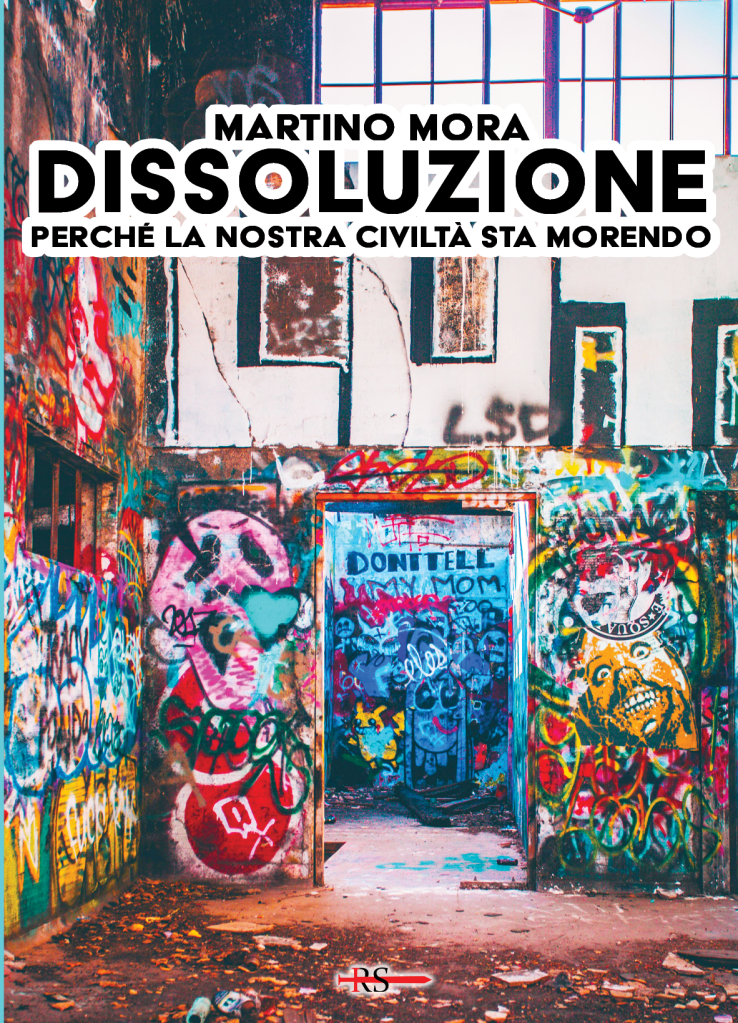
Martino Mora is a leading figure on the rebel front seeking to resist globalist oppression in Italy. In 2021, he also had his “fifteen minutes of fame” for a brilliant act of civil disobedience, having refused to teach a high school class in which a “gender” farce was being staged. Starting from that absurd event—reminiscent of the Cultural Revolution in Maoist China—Professor Mora began a journey of cultural dissemination that has made him a significant point of reference for unconventional thought.
In 2025, his book Dissoluzione. Perché la nostra civiltà sta morendo (Dissolution: Why Our Civilization is Dying ) was released. It is an important text that analyzes the stages of the Via Crucis that led the Western world to its current suicidal stance, which will likely end the civilization built on Greek philosophy and the Christian religion. This essay offers insights to identify and explore the causes that have led to the decadence of Western civilization.
Dissolution is a precise and detailed diagnosis of the causes of the unstoppable decline and the cupio dissolvi (desire for self-destruction) with which the Euro-American world has become afflicted. The discussion centers on the denunciation of the manipulative and fraudulent nature of liberal democracy, born from a long march of “calculating reason” and economism that have reduced the world to a market and man to a consumer. The point of no return was reached with the movement of 1968, an authentic anti-Christian epiphany that began the dystopian nightmare of the “upside-down world.” At the root of this approach to reality is individualism, the origins of which can be traced back to the problem of Universals that animated philosophical debate in the Middle Ages and concluded with the substantial primacy of nominalist thought, from which modern subjectivism takes shape. Mora supports his discourse with classic authors of the critique of modernity, predominantly of Catholic origin, such as Joseph De Maistre and Louis De Bonald. However, there are also insights derived from Nietzsche, Spengler, Evola, and Guénon, as well as references to the anthropologist Louis Dumont and contemporary scholars who have investigated the causes of nihilism, such as Emmanuel Todd.
Furthermore, an author Mora considers particularly suitable for examining the spirit of the “civilization of money” is Georg Simmel, author of the essay The Philosophy of Money. That text, published in 1900, can still be very useful in illustrating the capacity for “internal desertification” that the mercantilist spirit exerts on souls.
Mora divides the book into chapters that speak of globalist phenomena and techniques for the flattening of humanity: the Great Replacement, the Homosexualist Revolution, the eclipse of the Catholic Church…
This last theme is particularly close to the heart of Mora, a Catholic increasingly perplexed in the time of the “hallucinated ministries” of Bergoglio and his successor Prevost, whom Mora defines as a “Bergoglio with a human face”—that is, slightly more moderate in language than the Argentine Pope, but equally intent on dissolving the Church in the acid of ecumenism and ethical relativism. In Christian terms, globalization has all the characteristics of a satanic theocracy!
Finally, the book sums up the current apocalyptic climate, asking what posture “differentiated humanity”—those who do not accept globalist standardization—should adopt.
Under the banner of “human rights,” the globalist abomination has made a market of everything. Even children can be bought, starting from eggs and sperm, and there are even those who theorize the possibility of selling body organs, as argued by Argentine President Milei.
To supplement Mora’s observations, it should be noted that the masterpiece of mercantilist civilization has been the ability to monetize feelings. Progressive ideologies, based on hatred against the heterosexual white male, have succeeded in establishing legislation that punishes what they deem “hate” when such a feeling is directed at the categories the Left wants to install at the top of the social pyramid (mainly immigrants and homosexuals). The purpose of this legislation is not only to silence dissidents but, above all, to extract money in the form of compensation for “moral damages.” A similar argument applies to the legal apparatus regulating relationships between men and women, which has now become a tool for exercising legalized extortion against males.
We can expect, at this point, that any human relationship, even of a purely friendly nature, will be subjected to legal regulation and economic quantification!
Mora dedicates the final parts of the book to the Italian political and media scenario, which is dismal to say the least. The “sovereigntist” parties that should have been opponents of globalism are literally kept on a leash by the system: in Italy the Left dictates the political agenda even when it loses elections. In a country condemned by pitiless demographic statistics, the “Right” has done no better than to go along with immigrationism and feminism. While identity-based political movements effectively counter the globalist “Empire of Evil” in some countries, in Italy, the “Right-wing” political personnel appear to be of the lowest human level and, moreover, reflect the attitude of a passive, unmotivated population now sunk into a catatonic state.
Social disintegration is the fuel of the free market, which is why the Left is flooded with money from most of the great capitalists, giving progressives a decisive advantage in creating a manufactured consensus. However, a reason for hope is precisely this total disconnection between the ruling classes and the population. Even the oligarchies know that there is a large majority of the population that feels the weight of globalist tyranny: the victims of globalism are only waiting to become aware of their subordinate condition and have nothing to lose but… their chains!
As mentioned at the beginning, Mora’s book constitutes a careful diagnosis but remains rather vague regarding possible solutions. On a human level, all seems lost; however, Mora, as a Catholic, trusts in a divine intervention to rescue the Church understood as the Mystical Body of Christ (while placing no hope in a clergy sold out to globalist power).
On this point, we observe that a debate could be opened that would lead far: is Christianity the solution or is it the problem?
Mora himself cites Chesterton’s famous maxim: “The modern world is full of the old Christian virtues gone mad. “
After all, even without reaching Nietzsche, Machiavelli already noted that the Christian religion makes souls effeminate…
Can the message of Christ be the cure for the evil of individualism? Can it mean something that the Catholic Church, in the last half-century, has become the political training school for the Left?
Posterity will judge…
Mora’s essay is nonetheless a text that offers many useful indications for deconstructing progressive mythologies, regardless of the cultural backgrounds of the readers.
For now, let us treasure the insights offered by the courageous Milanese professor, keeping in mind the words of Joan of Arc that he himself quotes in his book:
“We must give battle, so that God may grant the victory!”
***
Martino Mora, Dissoluzione. Perché la nostra civiltà sta morendo,
Edizioni Radio Spada, 2025, 190 pp.
 LITTERAE - Homepage