
«And when the thousand years are ended, Satan will be released from his prison 8 and will come out eto deceive the nations that are at the four corners of the earth, Gog and Magog, to gather them for battle; their number is like the sand of the sea. 9 And they marched up over the broad plain of the earth and surrounded ithe camp of the saints and jthe beloved city, but fire came down from heaven and consumed them ».
Apocalypse 20, 7-9
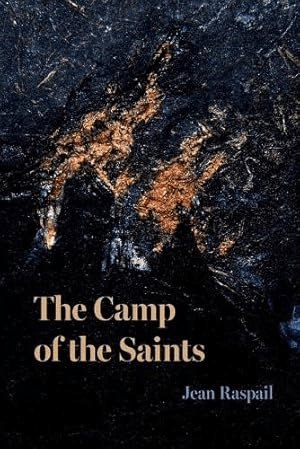
From this biblical quotation is taken the title of the apocalyptic novel The Camp of the Saints by Jean Raspail, published in 1973.
Briefly, the plot of the work is as follows: in 1997, a mob of poor people from India decides to seize a fleet to invade Europe. The mob, led by a sinister figure known as the ‘coprophage’, with the complicity of Christian missionaries and ‘humanitarian’ organisations, succeeds in their intent and begins their threatening journey. The ruling classes of the European nations are bewildered by the events and all they can imagine is preparing the ground for the invasion by means of a hammering propaganda campaign to make public opinion accept the advent of the multiracial society. When the immigrant fleet arrives on the Côte d’Azur, a group of Frenchmen attempting to resist is bombarded by the same French air force sent by the government to protect the immigrants’ triumphal march. The immigrants then find no opposition militarily, let alone institutionally: a neo-communist regime is immediately established that expropriates homes from their owners and starts the occupations of houses by the black hordes. Raspail, with an effective simile, compares the invasion of the West by immigrants to the fall of Constantinople conquered by the Turks in 1453.
Raspail’s stylistic expertise is truly masterful: the novel, centred on the relatively short time of the few weeks it takes ships to travel from India to Europe, delves deep into the collective psychology of the human groups that are the novel’s protagonists. The masses of immigrants are driven by a spirit of conquest, and pursue their goal with unwavering conviction, refusing any offer of compromise. The Westerners who are accomplices of the immigrants, missionaries and politicians, on the other hand, are driven by personal gain and endless resentment, and feel entirely devoted to the cause of the annihilation of their own civilisation. But Raspail’s literary genius manifests itself above all in his description of the European populations, subjected to the constant hammering of multiracial propaganda, which is mostly passively accepted, even if at times the citizens are touched by doubts as to whether the advent of the multi-ethnic ecumene is really the best of all possible worlds. Raspail’s pen reaches tragicomic heights that are hard to match when he describes primary school children who, instigated by their teachers, draw immigrants going to school, to work, to the shops…
Not to mention a song about reception specially commissioned by the government and broadcast on all radio and television stations with manic repetitiveness.
Raspail’s work is cynical and disillusioned, and in this harshness there is all the evil will that drives the occult forces to build the satanic kingdom of globalisation: the imposition of mestizaje has produced a scenario of institutional chaos, daily violence and generalised degradation that well summarises the attitudes and objectives of the globalist ruling class.
The Camp of the Saints may have seemed like a work of political fiction when it came out, but within a short time Europe was swept by a wave of migration that drew public attention to this text and even inspired a fine film: The Second Civil War (directed by Joe Dante, 1997). Unfortunately, it was not only alternative culture enthusiasts who took an interest in The Camp of the Saints, but also ‘democratic’ censors, who tried to conceal the novel or at least keep it away from the circuits of large-scale publishing distribution.
More than 50 years after the book’s publication, it must unfortunately be noted that the sad reality has now overtaken the French novelist’s imagination, but The Camp of the Saints is still a provocative and regenerating reading for those who do not want to surrender to the globalist thought.
***
Jean Raspail, The Camp of the Saints, vauban Books, 2025
 LITTERAE - Homepage