
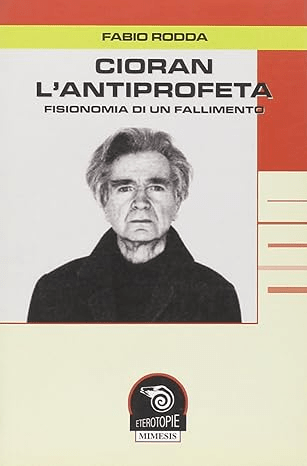
Emil Cioran, the philosopher of despair who better than anyone else explored the feeling of anguish, is still a little-studied figure given the crucial importance of his work. A significant contribution to a greater understanding of the Romanian thinker is Fabio Rodda’s book, Cioran, l’antiprofeta. Fisionomia di un fallimento (“Cioran, the Antiprophet. Physiognomy of a Failure”). Rodda, a young philosophy scholar and graduate of the University of Bologna, made a brilliant debut on the literary scene with this thorough and well-researched essay.
The first part of the book analyzes Cioran’s Romanian period. In 1933, at just 22 years old, Cioran published On the Height of Despair, a work characterized by remarkable maturity and stylistic certainty, which was immediately appreciated by the intellectual world. Even in this first publication, the fundamental themes of Cioran’s thought emerge: nihilism, anguish, the pain of living, and existential disorientation. On the height of Despair also attracted reader’s attention for his choice of language, not purely philosophical, but decidedly lyrical. This youthful period also included his support for the “Legion of the Archangel Michael,” Codreanu’s political movement, which, with its mystical and apocalyptic nationalism, fascinated the most brilliant minds in Romania at the time. In 1936, Cioran wrote the nationalist essay Schimbarea la față a României (“The Transfiguration of Romania”) and collaborated with far-right magazines, writing articles that would later provide his opponents with the pretext for a predictable accusation of “fascism,” which, naturally, would damage his intellectual career.
Rodda, who makes no secret of his sympathy for liberal democracies, nevertheless reveals an ability to unprejudicedly grasp the motivations that inspired the ideological choices of Cioran and many intellectuals who lived in those historical junctures, and objectively analyzes some of Cioran’s consensus statements regarding nationalist regimes. Cioran, however, had no ambitions for a political career, and by the late 1930s, he had already shown little interest in the events involving Romania during the tumultuous years of the Antonescu regime. The philosopher continued his intellectual journey by publishing in 1937 Tears and Saints, a major work that explores the dimension of faith and the condition of sanctity, which Cioran defines as an “exact science.” Cioran, an anti-dogmatic thinker by definition, condemns the systematization of faith in theology and is fascinated by the vertigo of mystical experience, through which man approaches that indeterminable dimension to which he instinctively tends and which he can touch in moments of ecstatic rapture. This book also highlights Cioran’s particular interest in music, seen as a privileged means of approaching the transcendent. The second part of the essay is dedicated to the period that began with Cioran’s move to Paris in 1937.
The Romanian philosopher decided to write in French, a language that allowed his works to be much more widely distributed, and in 1949 his masterpiece, A Short History of Decay, was published. This book is a kind of prose poem in which the human condition is viewed with merciless lucidity in its absolute meaninglessness and the impossibility of any foundation: the analysis of existential positions is pushed beyond limits that even Leopardi and Schopenhauer had not dared to transgress. Rodda also analyses Cioran’s relationship with the culture of the time, and in particular with that of engaged France, in which Sartre was the intellectual of reference. Naturally, Cioran’s thought, entirely focused on the exploration of nihilism, could not be in tune with the superficial optimism of progressive intellectuals, and while Sartre led the crowds of 68 in the squares of Paris, Cioran lived on the threshold of poverty in the modest attic where he had found a home. Cioran’s intellectual activity continued with the publication of other important books in which the thinker continued to reiterate the total lack of meaning in life, going so far as to define failure as the inescapable horizon of human experience. Particularly interesting is History and Utopia (1960), which examines man’s two fundamental attitudes towards history: the time of action, which is a mad enthusiasm blinded by contingency, and utopia, which is an illusion provided by history itself as a way out of it. With extraordinary foresight, Cioran outlines in History and Utopia the demonic horizon of globalization, and writes: «the dispersed human flock will be reunited under the guard of a ruthless shepherd, a sort of planetary monster before which the nations will prostrate themselves, in a state of dismay bordering on ecstasy».
In the final chapter, Rodda notes how Cioran’s thought has become an essential point of reference for navigating an era of great uncertainty that calls for new cultural and ideological syntheses. Cioran, a master of aporia, yet never lost his passion for research and discussion, develops an “incendiary” thought capable of challenging every dogma. Rodda cites at the end of the book a quote from the great Romanian thinker that effectively describes the sense of uprootedness afflicting the contemporary world: “I am a metaphysical stateless person, a bit like those Stoics at the end of the Roman Empire who felt they were ‘citizens of the world,’ which is to say they were citizens of no place».
Fabio Rodda, Cioran, l’antiprofeta. Fisionomia di un fallimento, Mimesis, Milano 2006, pp.214
 LITTERAE - Homepage