
Can the Muse Sing Again?
FREE PDF
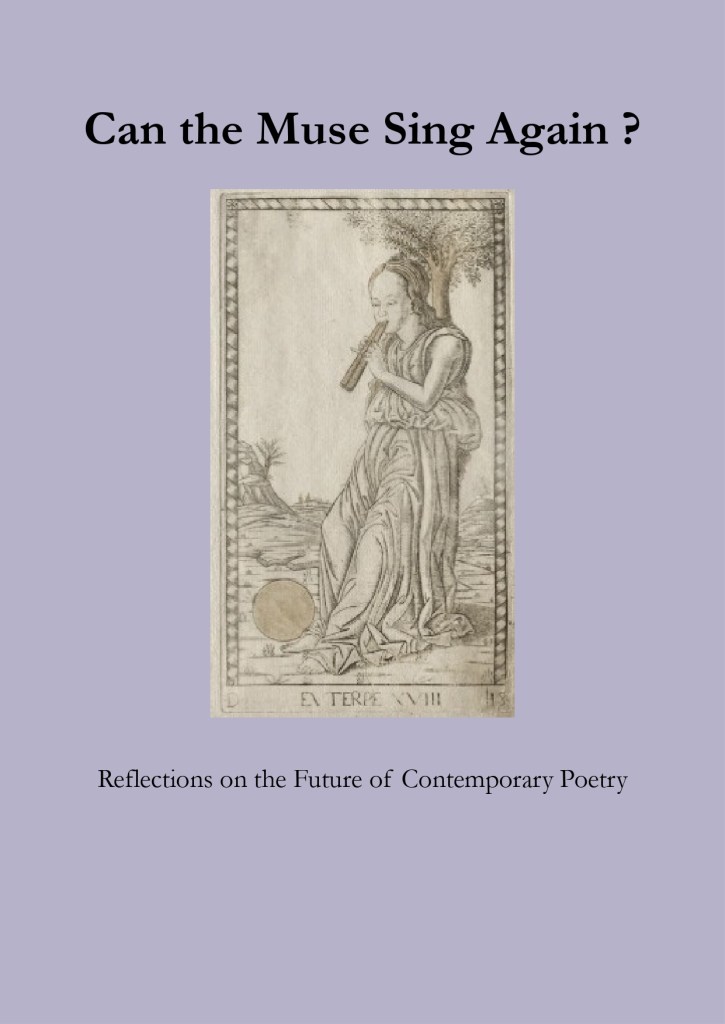
Poetry, as is well known, has for several decades now become the Cinderella of literature. The art of verse is essentially alien to the contemporary reader’s mindset, and poetry books have a negligible impact on the book market. Apparently, then, poetry seems relegated to a small circle of professionals, or to a crowd of amateurs who think they are poets because every now and then they write with a line break…
But there are also some who wonder if there might be alternative horizons for what was once the queen of literary expression.
Among the voices proposing new ways of approaching the public, Ivan Pozzoni stands out for his originality. He has drafted an “Anti-Manifesto” of the “Neon-avant-garde,” not without inspiration for those who aspire to speak to the public with renewed modes of expression.
The key points of Pozzoni’s Manifesto are the following:- challenge nomadic capitalisms and multinational authorities- place faith in dialogue between even profoundly different cultural worlds, which can give rise to fruitful syntheses- encourage the production of collective and anonymous artistic forms that escape market logic- learn to engage in cultural “terrorism” to counter the nihilistic ontology that permeates our time- focus on a renewed appreciation of irony as a means of overturning dominant narratives- think of the figure of the intellectual in terms of militancy- acknowledge the exhaustion of the function that literary criticism had in the 20th centuryThese programmatic points appear decidedly intriguing to those who perceive the climate of suffocating conformism plaguing the contemporary scene: the intellectuals of the last thirty years have been unable to do better than pose as court poets of globalist power!The world of poetry seems particularly removed from cultural debate. Contemporary poetry, an insignificant sector in the book market, is characterized by the fragmentation of writing experiences, with authors gathered in catacomb-like cliques or isolated in pathetic literary narcissisms.Some of Pozzoni’s proposals can certainly provide a boost to a literary world mired in immobility. In particular, the invitation to dialogue between languages, besides being ethically important, distances itself from elitist closures and enriches fields that might seem arid from certain perspectives.Overcoming the artist’s ego is a particularly stimulating theme in Pozzoni’s reflections. While abandoning the ego risks compromising the originality of his works, it can nevertheless pave the way for a new/ancient conception of the literary work. Indeed, the internet’s frontier fosters a practice of disseminating and enjoying literature that opens up to forms of collective sharing that evoke the idea of creative work as an expression of shared sentiments through an impersonal voice: a concept that recalls the shared enjoyment of art typical of past centuries, particularly Antiquity and the Middle Ages.Pozzoni traces the beginning of the literary ego to Dante Alighieri and the transition from the Middle Ages to Humanism: the father of Italian literature represents the summa of medieval literary expression, but also the beginning of a new era, an era whose conceptions of creative work still influence contemporary practices.Another interesting aspect is the emphasis on irony, an especially timely attitude in a time when the grip of political correctness has strangled free expression and the spontaneity of social behavior. This is certainly the most problematic point, as current ethics have been reshaped based on austere moral codes that have profoundly altered mass psychology. Irony, mockery, humor, and sarcasm today risk being relegated to the all-encompassing category of “discrimination,” or, worse still, these elements aren’t even perceived…
We’ve now reached forms of self-censorship that have taken us back to the time of the Inquisition or projected us into the dystopian future of Orwellian thoughtcrime!Finally, Pozzoni emphasizes the importance of a militant attitude. In the age of globalization, most intellectuals have done nothing but retreat into ivory towers, carving out a niche of media visibility that is entirely unproductive for broadening public awareness. Pozzoni obviously doesn’t mean militancy in the sense of partisan commitment, but rather as a call to ethics and responsibility toward a reality that increasingly lends itself to challenging established positions.Pozzoni, like many other intellectuals, deplores the proliferation of publishing houses and the practice of self-publishing, which have given rise to the phenomenon of mass amateurism. However, it should also be noted that this widespread publishing opportunity offers an opportunity for original and unconventional voices that are excluded from the mainstream publishing circuit. In short, more poetry has never been written than today. The challenge is rather to stimulate the public’s sensitivity to poetic expression, restoring strength and moral vigor to a language that, trivialized by the mass media, has been drained of energy and the ability to move consciences. In this regard, the web offers great opportunities, but it would be appropriate to ask how to integrate internet resources with other tools: artistic performances, spaces for public sharing, and initiatives that engage audiences, even those unaccustomed to enjoying poetic texts.Pozzoni’s guiding ideas seem like a useful provocation to stir the murky waters of the current cultural landscape. Starting from these assumptions, we can demonstrate the desire to create a movement capable of drawing media attention to a potentially surprisingly innovative cultural phenomenon.
AD MAIORA
_____________________________
Blog edited by Ivan Pozzoni
kolektivnenseae.substack.com/
 LITTERAE - Homepage